
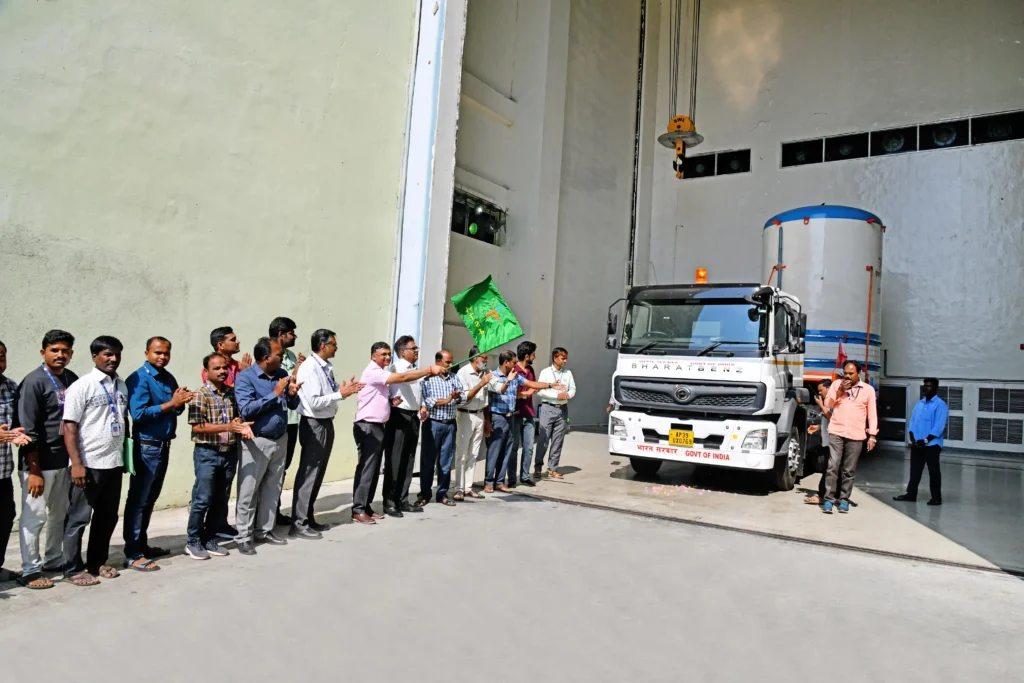
India’s space agency prepares for a high-intensity phase featuring the massive Bluebird-6, uncrewed Gaganyaan, and next-gen tech
The Indian Space Research Organisation (ISRO) is officially entering one of the most intense operational periods in its history. According to a recent announcement by Union Minister Jitendra Singh, the agency has finalised a schedule for ISRO seven launches to be completed by March 2026. This aggressive timeline includes a diverse mix of commercial contracts, strategic defence satellites, and critical precursors to India’s human spaceflight programme. Consequently, the spaceport at Sriharikota will witness a flurry of activity, starting as early as next week.
Also Read: India Shines as Diwali Earns Coveted UNESCO Heritage Status
The Heavyweights: LVM3 Takes Centre Stage
A major highlight of the ISRO seven launches is the deployment of India’s heaviest rocket, the LVM3. It is scheduled to carry the Bluebird-6 communication satellite for US-based AST SpaceMobile on December 21. This mission underscores the growing commercial clout of NewSpace India Limited (NSIL). Following this, the LVM3 will be repurposed for the highly anticipated Gaganyaan G1 mission. This uncrewed flight will carry the humanoid robot “Vyommitra” to test life support and safety systems. Therefore, the success of these consecutive heavy-lift missions is pivotal for establishing India’s reliability in the global launch market.
Advancing Tech with PSLV and GSLV
The schedule also features multiple flights of the workhorse Polar Satellite Launch Vehicle (PSLV). One notable mission involves the first industry-built PSLV, which will deploy the Oceansat-3A satellite along with payloads from Mauritius and Dhruva Space. Another critical mission in the ISRO seven launches lineup is the PSLV-C63, carrying the Technology Demonstration Satellite (TDS-01). Additionally, the GSLV Mk-II will return to the pad to launch EOS-5 (GISAT-1A), replacing a satellite lost in 2021. This mix of vehicles ensures that both remote sensing and navigation needs are met without delay.
Strategic Shifts and Future Readiness
Beyond routine deployments, the ISRO seven launches aim to validate next-generation technologies. The TDS-01 mission is particularly significant as it will test indigenous High Thrust Electric Propulsion (HTEP) and Quantum Key Distribution systems. Furthermore, the Small Satellite Launch Vehicle (SSLV) is slated for a dedicated commercial flight. This ensures that ISRO captures the growing market for small-satellite constellations. Thus, this period is not just about frequency; it is about transitioning from experimental phases to fully operational, revenue-generating capabilities across all vehicle classes.
The Hinge Point
While the media frenzy focuses on the sheer number of missions, the real technological leap in the ISRO seven launches schedule is the High Thrust Electric Propulsion (HTEP) test on TDS-01. Currently, a standard 4-tonne satellite carries nearly 2 tonnes of chemical fuel. The new HTEP system reduces this fuel mass to just 200 kg. This effectively allows a lighter 2-tonne satellite to perform the same functions as a heavy 4-tonne legacy satellite. It fundamentally alters the economics of launch mass, negating the immediate need for larger rockets by making the satellites themselves drastically more efficient.