
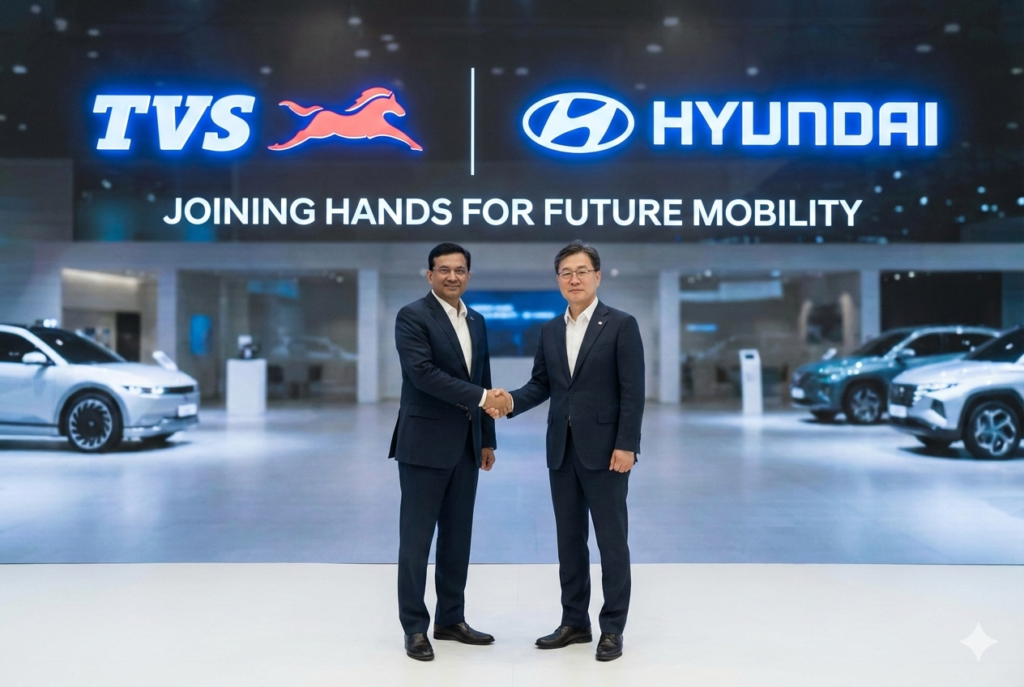
Industry buzz grows as TVS and Hyundai weigh collaboration that could reshape India’s two and three-wheeler market
India’s automotive sector is abuzz with speculation that TVS Motor Company and Hyundai Motor Company could be coming together in a strategic move to challenge Bajaj Auto. While no formal announcement has been made, industry conversations suggest that discussions around technology sharing and market expansion are gaining momentum.
If it materialises, a TVS Hyundai partnership could mark one of the most significant alignments in India’s fast-evolving mobility landscape. Moreover, it would bring together deep expertise in two-wheelers with global strength in electric and connected vehicle technology.
Also Read: India’s Startup Ecosystem Hits Historic Milestone With 2 Lakh Ventures
Why this alignment matters now
The timing of the potential TVS Hyundai partnership is crucial. Demand patterns in India are shifting, as consumers seek cleaner mobility, better features and reliable performance at competitive prices. At the same time, regulatory pressure on emissions and safety continues to rise.
TVS has built a strong domestic and export presence in motorcycles and scooters. Hyundai, meanwhile, has invested heavily in electric mobility and future-ready platforms. Therefore, a collaboration could allow both companies to accelerate innovation while sharing costs.
Bajaj’s stronghold under watch
Bajaj Auto has long dominated segments such as three-wheelers and premium motorcycles. It also enjoys a robust export footprint across Africa, Latin America and South Asia. Consequently, any challenge to Bajaj requires scale, technology depth and manufacturing efficiency.
A TVS Hyundai partnership could check these boxes. TVS brings agility and segment knowledge, while Hyundai contributes global R&D capabilities. Together, they could pressure Bajaj in both domestic and overseas markets.
What the companies have said so far
So far, both companies have maintained silence on formal talks. However, neither has outright denied industry chatter. This has kept analysts on alert, especially since Hyundai has previously signalled its interest in expanding its two-wheeler and micro-mobility footprint.
In contrast, TVS has spoken openly about partnerships that enhance electric and digital capabilities. Hence, the idea of a TVS Hyundai partnership fits into broader strategic narratives already visible in public statements.
Implications for the auto ecosystem
If the TVS Hyundai partnership moves ahead, it could trigger fresh consolidation talks across the sector. Suppliers, startups and logistics players would also feel the ripple effects. Importantly, consumers could benefit from faster product launches and sharper pricing.
At the same time, competition would intensify. Bajaj may respond by doubling down on innovation or exploring alliances of its own. As a result, the Indian auto market could enter a more collaborative yet competitive phase.
The Hinge Point
What remains underexplored is the structural logic behind such a move. India’s two-wheeler market is approaching saturation in urban centres. Growth is shifting towards exports, electric vehicles and rural demand recovery. In this context, partnerships offer a way to de-risk investments while scaling faster.
A TVS Hyundai partnership would not just be about rivalling Bajaj. It would signal a larger transition in how Indian auto majors compete globally. Instead of going solo, firms may increasingly rely on strategic alignment to tackle capital-intensive technology shifts. That shift, more than any single deal, could redefine the industry’s next decade.