
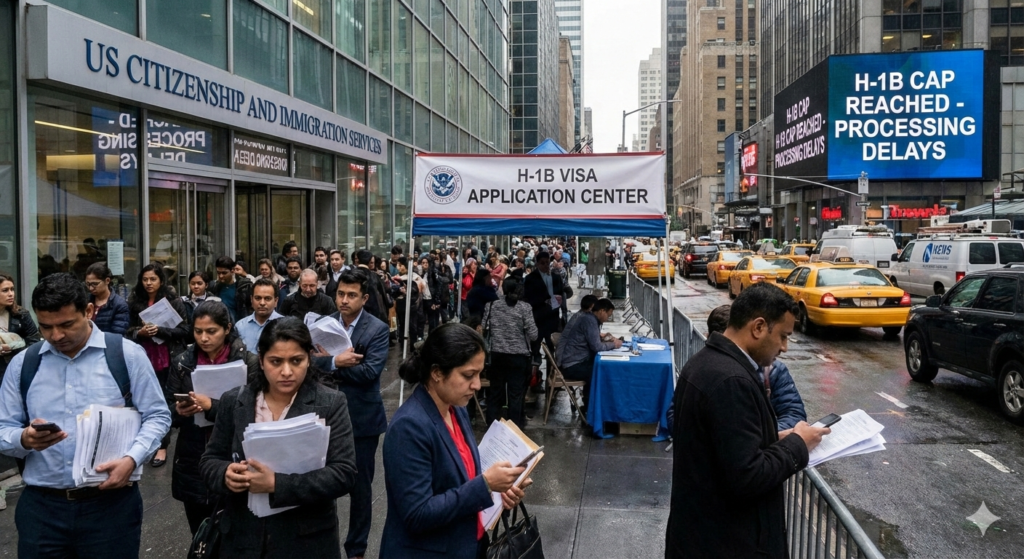
A once predictable visa regime is now revealing how political volatility rewires talent, firms, and state power
For over three decades, the H-1B visa regime has been understood as a technocratic instrument. It was designed to allow American firms to access specialised global talent while maintaining formal control through quotas, compliance, and employer sponsorship. Disagreements around it have always existed, yet they followed a familiar script. Labour unions questioned wage suppression. Tech firms argued skill shortages. Politicians framed it as either economic necessity or immigration excess.
That script assumed one thing above all else. The system itself was stable. Even when administrations changed, the H-1B visa regime was treated as a slow moving structure. Rules evolved. Scrutiny rose or fell. However, the underlying bargain remained legible to everyone involved.
That assumption no longer holds.
What appears today as administrative churn or political signalling is better understood as something deeper. The H-1B visa regime has shifted from being an infrastructure of access to a mechanism of pressure. Its unpredictability is no longer accidental. It is functional.
Where strain begins to show
The strain did not emerge because of one executive order or one policy memo. It surfaced gradually, through accumulation. Processing timelines lengthened without clear explanation. Approval standards tightened unevenly across sectors. Requests for evidence multiplied even when job roles had not materially changed. Employers began treating approvals as contingent rather than expected.
For visa holders, the experience changed more sharply. Status became fragile. Career planning shortened. Mobility within firms narrowed. The psychological contract that once underpinned the H-1B visa regime began to erode.
This is where the dominant narrative starts to fail. Public debate continues to frame the issue as political hostility toward immigration or as episodic administrative disruption. That framing cannot explain why volatility persists even when policy rhetoric moderates. It also cannot explain why uncertainty itself has become the defining feature of the system.
Volatility here is not noise. It is the signal.
The organising logic beneath the chaos
The H-1B visa regime was never just an immigration instrument. It was also an economic coordination mechanism. By tying skilled migrants to employers, the state embedded itself into labour markets without directly managing them. Predictability was essential for this arrangement to function.
Once predictability weakens, behaviour changes everywhere.
Firms respond first. Large technology companies now hedge talent risk structurally. Offshore hiring increases even when domestic demand remains strong. Internal mobility is redesigned to reduce dependence on visa transitions. Legal teams become central to workforce planning rather than peripheral.
Mid sized firms adapt differently. Many stop sponsoring altogether. Others concentrate sponsorship within narrow roles that are easiest to defend administratively. Innovation slows in places that cannot absorb visa risk.
Talent responds next. Skilled workers shorten their planning horizon. Some treat the United States as a temporary extraction market rather than a long term base. Others redirect ambition entirely, choosing Canada, Europe, or the Gulf where pathways, even if imperfect, are legible.
States respond last. Countries that once treated outward migration as a brain drain now see returning talent as an asset. Policy incentives quietly shift to absorb experience accumulated under uncertainty.
This is the organising logic most commentary misses. The H-1B visa regime now functions as a sorting device. It does not simply decide who enters. It decides who commits.
Why unpredictability persists
If instability harms firms, workers, and even administrative capacity, why does it persist?
Because unpredictability concentrates power.
A predictable system distributes agency. Employers plan. Workers negotiate. Institutions stabilise expectations. An unpredictable system reverses this. Discretion expands. Compliance replaces entitlement. Every approval becomes provisional. Every denial becomes instructive.
Under such conditions, the state no longer needs sweeping reform to shape outcomes. It governs through friction. Small delays, ambiguous standards, and uneven enforcement achieve what explicit policy shifts cannot.
This is why changes to the H-1B visa regime often appear incoherent. Coherence would reduce leverage. Ambiguity preserves it.
This logic also explains why legal challenges rarely restore equilibrium. Courts can overturn specific actions. They cannot reinstate predictability as a norm.
What behaviour now looks different
Once systems lose reliability, adaptation accelerates in quiet ways.
Career risk is now priced into compensation negotiations. Some workers accept lower wages in exchange for sponsorship certainty. Others prioritise internal transfers over role fit. Entrepreneurship among visa holders declines, not due to lack of ambition but due to asymmetric risk exposure.
Employers recalibrate trust. Performance is no longer the sole metric of retention. Visa status becomes an operational variable. This distorts internal hierarchies and decision making in ways firms rarely acknowledge publicly.
Educational institutions feel the shift as well. International enrolments in STEM fields remain strong, yet intent changes. Students hedge by pursuing credentials that preserve optionality rather than specialisation.
None of this registers clearly in headline data. Approval rates fluctuate. Application volumes adjust. However, the deeper behavioural shift is cumulative. The H-1B visa regime no longer anchors expectations. It destabilises them.
The limits of reform narratives
Calls to reform the H-1B visa regime often assume restoration. Increase caps. Streamline processing. Clarify standards. These measures matter, yet they misread the moment.
Restoration requires shared belief in institutional continuity. That belief has already fractured.
Even if legislative reform occurs, behaviour will lag. Trust, once broken, does not reset with new rules. Firms will continue to diversify risk. Workers will continue to hedge. Alternative pathways will remain attractive.
This is why the debate cannot be reduced to partisan cycles. The system has crossed a threshold where perception shapes reality more than formal policy.
What this means beyond visas
The implications extend beyond immigration.
The H-1B visa regime now offers a case study in how advanced economies manage global dependence under domestic political stress. Rather than closing borders outright, they introduce uncertainty. Rather than banning mobility, they make it costly to rely on.
This approach preserves flexibility while avoiding accountability. It also reshapes global flows without explicit declaration.
For countries like India, the lesson is sobering. Talent strategy can no longer be built around assumed access to any single market. Domestic ecosystems must absorb volatility rather than export it. Firms must design careers that do not hinge on external predictability.
The hinge in this story is not policy change. It is expectation collapse.
The open end
The H-1B visa regime will continue to exist. Applications will continue. Approvals will still happen. Headlines will move on.
Yet something fundamental has shifted.
A system once designed to enable commitment now conditions behaviour through doubt. How long that model remains sustainable, and what replaces it when it fractures further, remains unresolved.
What is already clear is this. The question is no longer who qualifies for the H-1B visa regime. The question is who is willing to build a future inside a system that no longer promises continuity.