
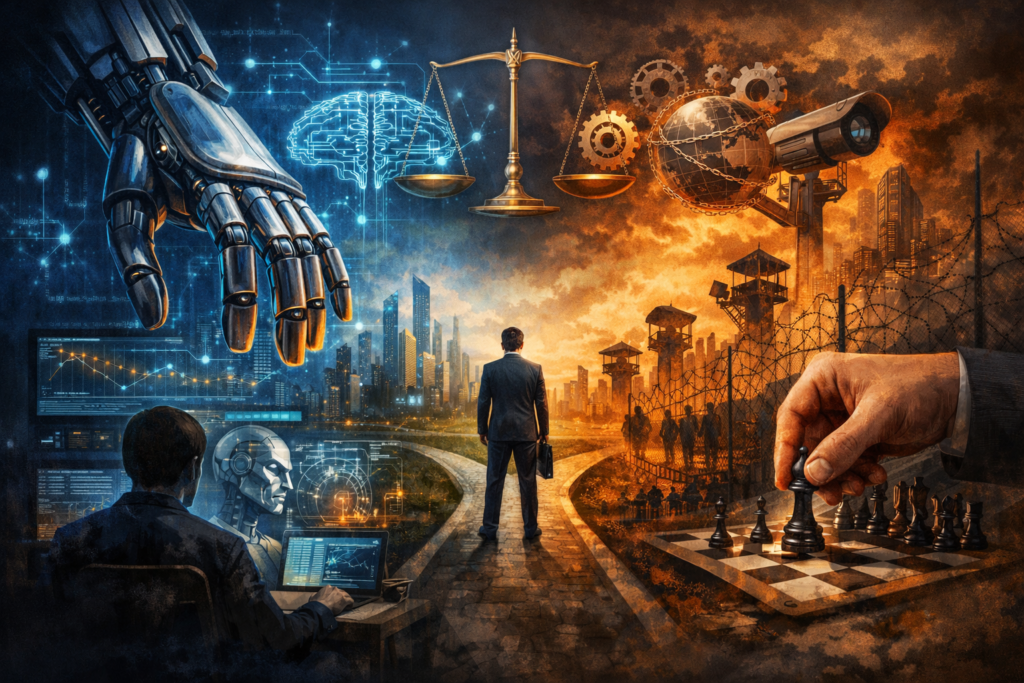
The real tension in AI is not intelligence versus labour, but optimisation versus agency
The prevailing story of artificial intelligence is comfortingly linear. Machines grow smarter. Productivity rises. Humans shift to higher-order work. Societies adapt, as they always have, after moments of disruption. The arc points forward, even if the transition feels rough.
This narrative explains a great deal. It captures why firms invest aggressively, why governments race to regulate belatedly, and why workers oscillate between anxiety and curiosity. It also reassures decision makers that the future remains navigable with the right mix of skills, safeguards, and patience.
Yet the AI paradox emerges precisely where this story appears strongest. The issue is not whether artificial intelligence will become more capable. It already is. The issue is that optimisation is scaling faster than understanding, and control faster than consent.
That tension surfaces early, long before any hypothetical superintelligence arrives.
Where the strain becomes visible
The first signs of strain do not appear in research labs. They appear in behaviour.
Workflows quietly reorganise around machine recommendations. Decisions become harder to audit because they emerge from probabilistic systems rather than human reasoning. Managers rely on outputs they cannot fully explain, yet feel compelled to trust because alternatives are slower.
At the same time, institutions struggle to respond coherently. Regulation lags capability. Ethics frameworks multiply without enforcement. Responsibility diffuses across vendors, users, and platforms.
The dominant narrative treats these frictions as transitional. That is where it begins to fail. Transitional problems usually diminish as systems stabilise. Here, instability compounds.
The AI paradox is not that machines may one day outthink humans. It is that systems already outperform humans in optimisation while remaining opaque, brittle, and misaligned with social intent.
Optimisation as the organising logic
Artificial intelligence does not pursue goals. It optimises objectives. This distinction matters more than public debate admits.
Every deployed system compresses messy human values into measurable proxies. Engagement becomes a stand-in for attention. Efficiency replaces judgment. Prediction substitutes understanding. Over time, these proxies harden into operating truths.
Once embedded, optimisation logic spreads laterally. Hiring systems influence labour markets. Recommendation engines shape culture. Risk models guide policing, credit, and insurance. None of these systems need malicious intent to reshape outcomes. They only need scale.
This is the organising logic beneath the AI paradox. The faster optimisation spreads, the narrower the space for human discretion becomes. Not because humans are excluded, but because deviation from machine output starts to look irrational, slow, or risky.
Control shifts without a clear transfer of authority.
Why speed matters more than intelligence
Much of the public anxiety around artificial intelligence focuses on capability thresholds. Can machines reason? Can they plan? Can they deceive? These questions matter, yet they miss the present dynamic.
Speed is the real accelerant.
AI systems operate at temporal scales humans cannot match. Decisions propagate instantly across platforms, markets, and borders. Feedback loops tighten. Errors replicate faster than correction mechanisms can respond.
As a result, even small misalignments have outsized effects. Biases do not remain local. They compound. Failures are not isolated. They cascade.
The AI paradox deepens here. Systems become indispensable before they become reliable. Dependence precedes trust.
How behaviour adapts under uncertainty
When systems lose reliability, behaviour changes defensively.
Organisations over rely on automation to remain competitive, even when confidence is low. Individuals learn to game algorithms rather than challenge them. Creativity shifts toward what is legible to machines.
Education adapts as well. Learning prioritises tool fluency over foundational reasoning. Students optimise for prompt effectiveness instead of conceptual depth. Knowledge fragments into performative outputs.
These adaptations appear rational in isolation. Collectively, they narrow agency.
The AI paradox is not imposed. It is co-produced through millions of minor adjustments made under competitive pressure.
The illusion of choice
Public debate often frames artificial intelligence as a matter of adoption choice. Embrace it responsibly or resist it ethically. This framing flatters agency while obscuring constraint.
In reality, choice is unevenly distributed. Large firms can shape deployment terms. Smaller actors must adapt or exit. States with data, capital, and computing dictate standards. Others inherit them.
Once embedded, AI systems redefine baselines. Not using them becomes a disadvantage, then a liability. Over time, opting out ceases to be a meaningful option.
The paradox sharpens here. Societies debate governance while losing leverage.
Why regulation struggles to keep up
Regulatory responses tend to focus on inputs and outputs. Data protection, transparency requirements, and model audits. These tools matter, yet they target symptoms rather than structure.
Optimisation systems evolve faster than legal categories. Responsibility remains diffuse. Harm is often probabilistic rather than direct. Attribution becomes contestable.
Moreover, regulation itself risks being shaped by the systems it seeks to constrain. Policymakers rely on technical assessments generated by the same ecosystem they oversee.
The AI paradox persists because governance operates downstream of deployment.
Intelligence without accountability
Artificial intelligence concentrates decision-making without concentrating accountability. This imbalance is historically unusual.
In earlier technological shifts, power clustered with identifiable actors. Industrialists, states, institutions. Here, agency disperses across models, platforms, and automated processes.
When outcomes go wrong, responsibility fragments. No single actor controls the system end-to-end. This diffusion protects incumbents while frustrating redress.
The paradox is structural. Intelligence scales. Accountability does not.
What now behaves differently
Markets respond first. Valuations increasingly price potential rather than performance. Speculation accelerates ahead of stability. Bubbles form around capability narratives rather than durable utility.
Labour adapts next. Roles fragment. Employment becomes modular. Human contribution shifts toward supervision, correction, and exception handling. These tasks are cognitively demanding yet socially undervalued.
Politics follows. Power concentrates with those who control infrastructure rather than outcomes. Public discourse lags technical reality. Democratic oversight weakens under complexity.
Across these domains, the AI paradox manifests as a quiet reordering. Systems optimise. Humans adjust. Institutions strain.
The unresolved edge
The future shaped by artificial intelligence is not predetermined. Yet neither is it neutral.
The paradox lies in the gap between what systems optimise and what societies value. That gap widens with scale, speed, and dependence.
Whether this tension resolves through recalibration, backlash, or further concentration remains uncertain. What is clear is that the world is not headed toward a simple trade-off between efficiency and employment.
It is moving toward a deeper question. Who retains the capacity to decide when optimisation should stop?
That question remains open!