
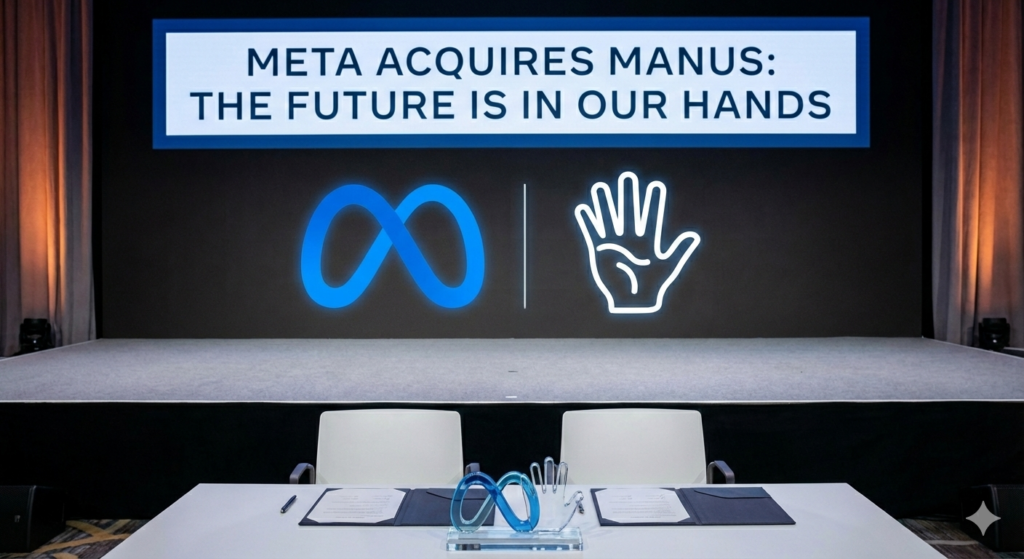
The deal signals a shift from model-building to system-level AI capability, reshaping how Big Tech scales intelligence
Meta acquires Manus, adding the company’s capabilities to its expanding artificial intelligence stack. While financial terms and integration details remain undisclosed, Meta has confirmed the acquisition. The announcement lands amid an intense phase of AI platform competition.
At the same time, the move matters because it reinforces Meta’s intent to control not just AI models, but also how intelligence is operationalised across products, platforms, and developer ecosystems.
Background to the acquisition
Manus has been positioned as a specialist AI company focused on applied intelligence rather than frontier model training. Its work has centred on building systems that translate large model capability into usable workflows. That orientation aligns with Meta’s recent shift towards practical deployment across social platforms, devices, and enterprise tools.
Meanwhile, Meta has invested heavily in open and proprietary models, infrastructure, and developer tooling. Therefore, the acquisition fits into a broader pattern of absorbing targeted expertise rather than building everything internally.
Why the timing matters
Meta acquires Manus at a moment when the AI race is no longer defined by headline model releases alone. Instead, performance, reliability, and integration speed have become decisive. As a result, companies are prioritising execution layers that sit between models and users.
Also Read: 24 tech giants rally behind Trump’s Genesis AI mission, signalling a new phase in US tech policy
At the same time, competitive pressure from rivals has intensified. Global peers are consolidating talent and technology to reduce dependence on third-party systems. Consequently, acquisitions like this reflect urgency rather than experimentation.
Immediate implications for Meta
In practical terms, Meta acquires Manus to shorten the distance between research output and product impact. Manus’ capabilities can be embedded into Meta’s AI assistants, content systems, and developer tools. This allows faster iteration across platforms that already operate at planetary scale.
Moreover, the deal reduces Meta’s reliance on external vendors for applied AI components. That matters as regulatory scrutiny grows and platform accountability becomes harder to outsource.
Global and systemic relevance
This acquisition sits within a wider global pattern. Large technology firms are increasingly absorbing smaller AI specialists to secure end-to-end control. As a result, the AI ecosystem is moving away from fragmentation towards vertically integrated stacks.
For startups and researchers, this shift narrows the space for independent scaling. For governments and regulators, it concentrates capability within a smaller number of firms with global reach.
The Hinge Point
The story turns because Meta acquires Manus not to chase a better model, but to lock down execution. Until now, the AI race rewarded those who trained the biggest systems. That phase is closing. What now defines advantage is the ability to deploy intelligence reliably, repeatedly, and at scale.
Once applied AI becomes the bottleneck, ownership of integration layers becomes strategic infrastructure. Meta’s move signals that these layers can no longer remain modular or external. Control must be internal, continuous, and deeply embedded into product architecture.
This changes the competitive landscape. AI leadership is no longer measured by benchmarks alone, but by how seamlessly intelligence reshapes user behaviour, developer dependence, and platform economics. With this acquisition, Meta positions itself on that terrain. The industry now follows.