
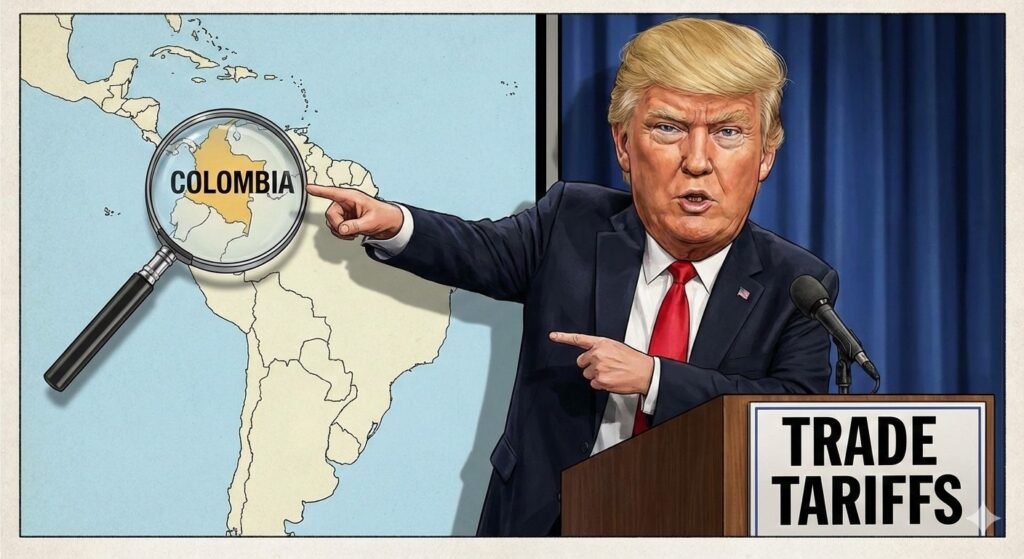
Post-strike rhetoric escalates fast as Washington’s focus shifts from Caracas to the wider Andean region
The United States carried out a military action against Venezuela, after which US President Donald Trump publicly threatened military measures against Colombia. The sequence matters because it reframes the episode from a bilateral confrontation into a regional signal.
The immediate concern is not the scale of the US strike on Venezuela, which remains limited in publicly available detail, but the speed with which rhetoric expanded. In global affairs, escalation by language often precedes escalation by posture.
Background to the confrontation
The US strike on Venezuela follows years of friction between Washington and Venezuela over governance, sanctions, and security claims. Although the precise targets and outcomes of the strike have not been officially detailed, the action fits a familiar pattern of pressure designed to assert deterrence.
However, this time, the aftermath has carried a different tone. Statements from Trump have explicitly named Colombia, a US partner in the region. That shift widens the frame from punitive action to regional alignment.
Why the timing matters
The timing of the US strike on Venezuela intersects with a volatile political calendar across the Americas. Transitions in leadership, domestic pressures in Washington, and unresolved migration and security concerns have compressed diplomatic patience.
As a result, signals are being sent faster and more publicly. When Trump spoke of military action against Colombia, the intent appeared less about immediate execution and more about redefining lines of obedience and consequence.
Also Read: US–Venezuela strike claims trigger North Korea response, exposing a sharper global fault line
Implications for Colombia and the region
Colombia occupies a sensitive position. It borders Venezuela, hosts US security cooperation, and manages spillover effects from Venezuelan instability. Therefore, invoking Colombia after a US strike on Venezuela introduces uncertainty into an alliance that relies on predictability.
For the region, this matters because it blurs the distinction between adversary and partner. Once that line weakens, regional governments must reassess how tightly their security choices bind them to Washington’s tactical decisions.
Global relevance beyond Latin America
Globally, the US strike on Venezuela and the subsequent threat language reinforce a broader trend. Military action is increasingly paired with expansive rhetorical reach. This combination amplifies risk even when force remains limited.
Moreover, allies elsewhere watch how quickly association can turn into exposure. That observation shapes defence planning far beyond Latin America.
The Hinge Point
The turning point lies in the expansion of the target set. The US strike on Venezuela, by itself, fits into an established playbook of coercive signalling. What changes the story is the decision to publicly extend military threats to Colombia.
At that moment, the logic shifts from disciplining a rival to testing the elasticity of alliance politics. Once partners are named in the same breath as adversaries, reassurance and deterrence begin to collide. That collision forces governments to choose between strategic alignment and sovereign distance.
What can no longer remain the same is the assumption that proximity to US power guarantees insulation from its pressure. The episode signals that regional order is being recast around compliance rather than partnership. That recalibration, more than the strike itself, marks the point where the story fundamentally changes.