
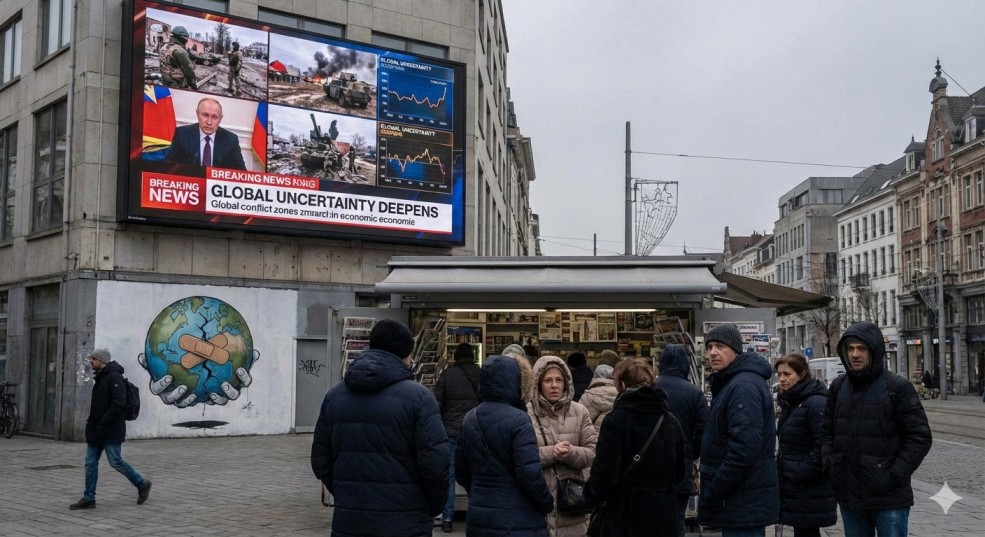
As enforcement weakens, states adapt faster than alliances, quietly reshaping how the global order actually holds
The dominant geopolitical story remains deceptively simple. A dangerous world has returned. Big powers are clashing again. Old conflicts have reawakened. Alliances are being tested. From Ukraine to the Red Sea, from Taiwan to Gaza, instability appears to be spreading.
Most readers, policymakers, and investors interpret this as a swing of the historical pendulum. After a long era of globalisation and relative calm, the world is assumed to be sliding back into rivalry. In this telling, the rules remain intact. What has changed is only who is challenging them.
Yet this framing already struggles to explain why so many actors now behave with visible confidence in defying pressure. Russia did not pause when sanctions were announced. Iran did not restrain its network of militias when warned. China did not soften its technology ambitions when export controls tightened. Even smaller players now push boundaries with less hesitation.
The surface narrative blames aggression, nationalism, or ideological revival. That is tidy. It is also incomplete.
What has shifted more quietly is not the appetite for power. It is the reliability of enforcement.
Where the strain is now visible
For decades, the international system depended on a simple assumption. If a state crossed too many red lines, consequences would arrive quickly, predictably, and at a scale that forced reconsideration. That belief shaped behaviour more than any treaty.
Today that certainty has weakened. Sanctions take longer to bite and are easier to route around. Military deterrence remains formidable but politically constrained. Trade penalties collide with domestic inflation and voter anger. Even diplomatic isolation is softer when much of the world is hedging rather than aligning.
The global enforcement gap emerges from this erosion. Power has not disappeared. The capacity to deploy it remains concentrated in a few hands. What no longer scales is the ability to impose that power cleanly across a deeply interdependent world.
Every major instrument of pressure now carries blowback. Cutting off trade hurts the enforcer. Financial sanctions fragment payment systems. Naval patrols stretch budgets and political patience. Even public shaming loses bite when alternative blocs offer diplomatic shelter.
This strain is not theoretical. It shows up whenever a crisis drags on without resolution. The longer conflicts endure, the more actors learn where enforcement falters. Each delay becomes a lesson.
How the organising logic has changed
The global system was never governed by goodwill. It was governed by credible fear. States complied not because rules were sacred but because breaking them was costly.
That logic required three things to function. Enforcement had to be fast. It had to be hard to evade. It had to be politically sustainable for those imposing it.
All three conditions now erode together.
Speed is lost as legal processes, coalition politics, and economic interdependence slow responses. Evasion grows easier as trade routes diversify and digital finance fragments. Political sustainability weakens as voters question why distant conflicts raise their fuel and food bills.
The global enforcement gap is the result of this triangulated weakening. It is not that no one enforces rules. It is that enforcement no longer arrives with the clarity that once shaped expectations.
Once expectations shift, behaviour follows.
States no longer ask whether an action breaks a rule. They ask whether the consequences will be bearable.
Why this feels different from past disorder
History is full of moments when rules were ignored. What makes the present moment distinct is how many actors now treat enforcement as negotiable.
In earlier eras, defiance usually triggered rapid escalation. Today it triggers prolonged bargaining through force, proxies, and economic signalling. That lengthens conflict without necessarily resolving it.
This creates a peculiar kind of stability. Wars do not end quickly. Sanctions do not compel surrender. Diplomacy does not restore clear lines. Instead, tensions remain suspended.
The global enforcement gap keeps conflicts alive without letting them explode or settle. That is why today’s world feels both dangerous and strangely frozen.
This is not the collapse of order. It is the slow hollowing out of its teeth.
How states are quietly adapting
As enforcement becomes less reliable, states do not announce defiance. They redesign exposure.
Energy buyers diversify suppliers even when it costs more. Central banks spread reserves across currencies. Defence planners stockpile rather than rely on just-in-time imports. Technology firms localise data and production.
These are not ideological moves. They are insurance.
Every government now plans for a future where rules might not be enforced when it matters. This planning accelerates fragmentation without anyone formally declaring a split.
The global enforcement gap thus reshapes behaviour long before it reshapes institutions. By the time treaties change, supply chains already have.
What alliances now struggle to do
Alliances still exist. They still issue statements. They still conduct exercises. What they increasingly struggle to do is act with automaticity.
Every collective response now requires domestic consent, fiscal room, and political timing. That makes reaction slower and more conditional.
Adversaries have learned to operate in these seams. They probe just below thresholds that would force unified action. They apply pressure through cyber tools, militias, shipping lanes, and regulatory grey zones.
The result is a world where rules technically hold but practically wobble.
This is not because alliances are weak. It is because enforcement has become more complicated than the rules it is meant to protect.
Why economic tools no longer dominate
Sanctions once promised clean punishment without war. They still matter. Yet their power now diffuses.
Global trade has grown too complex to isolate any major economy without hurting those imposing the penalties. Financial networks have developed parallel routes. Resource exporters find new buyers.
The global enforcement gap grows every time a sanctioned actor survives.
Each survival teaches others that pressure is manageable. That lesson travels fast.
How markets are reading this shift
Investors, insurers, and logistics firms already price in the enforcement gap, even when governments deny it.
Shipping rates spike in contested waters. Energy futures reflect geopolitical hedging. Supply contracts include more escape clauses. Political risk insurance becomes more expensive.
These are not reactions to single wars. They are responses to a system that no longer guarantees protection.
Capital flows where rules still bite. It avoids where enforcement feels thin.
Where the dominant narrative fails
The popular story claims the world is splitting into rival camps. That suggests new clarity will eventually replace old order.
What is emerging instead is messier. Overlapping alignments, partial compliance, and constant bargaining through pressure.
The global enforcement gap does not create two blocs. It creates a spectrum of risk where everyone keeps options open.
That is why even close partners hedge. That is why adversaries still trade. That is why neutrality grows.
The system is not dividing. It is loosening.
What now behaves differently
In this environment, small actions carry more weight than grand declarations. A shipping lane closure ripples across inflation. A technology ban alters investment flows. A currency swap shifts reserve strategies.
Because enforcement is uneven, these ripples do not cancel out. They accumulate.
States no longer expect protection to arrive on time. They plan for delay. Firms no longer trust trade routes to stay open. They duplicate. Consumers feel volatility not as crisis but as background noise.
The global enforcement gap quietly rewires how the world manages risk.
The rules still exist. Power still exists. What no longer exists is the shared belief that breaking them will always hurt enough to stop you.
And once that belief fades, the system begins to behave in ways no treaty was written to control.
As a reader from the development sector, the article’s argument on the global enforcement gap resonates deeply because its consequences are most visible not at the level of geopolitics, but in the everyday failures of development and rights delivery. Weak enforcement of global norms does not remain abstract; it translates into delayed climate finance, selective application of human rights standards, diluted labour protections, and unaccountable humanitarian interventions. When international rules lack credible enforcement, powerful states and corporations evade responsibility, while marginalised communities bear the cost through displacement, environmental degradation, and shrinking civic space.
From a development perspective, the enforcement gap reinforces existing inequalities between the Global North and South. Commitments on poverty eradication, gender justice, caste-based discrimination, and climate justice often remain aspirational because there are no binding consequences for non-compliance. This undermines trust in multilateral institutions and weakens locally driven development efforts, forcing communities and civil society to operate in a vacuum where promises outpace action.
The article rightly highlights behavioural shifts by states, but its implications for development governance deserve sharper attention: without enforceable global accountability, development risks becoming charity rather than justice. Bridging this gap requires not just stronger institutions, but people-centred enforcement mechanisms that prioritise rights, equity, and community accountability over geopolitical convenience.