
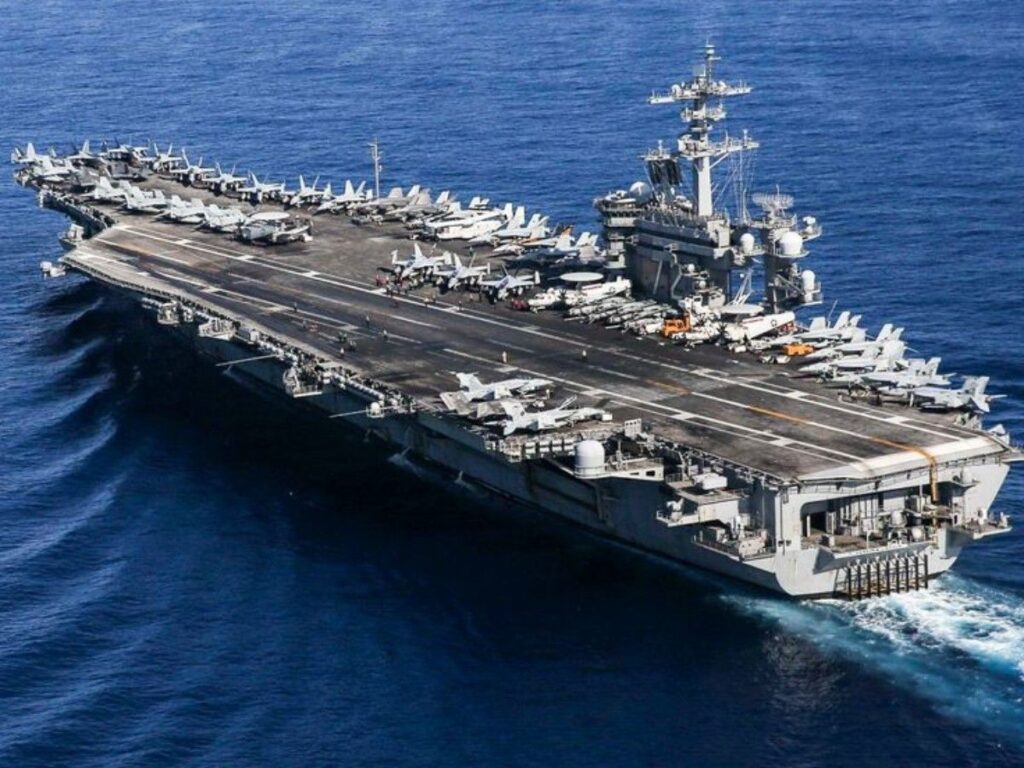
US President Donald Trump has escalated his standoff with Tehran, ordering a massive naval task force toward the Gulf and issuing a final warning to the Iranian leadership
The President of the US has dramatically raised the stakes in his “maximum pressure” campaign against Tehran by deploying what he describes as a massive armada to the Persian Gulf. Writing on social media this Wednesday, the President warned that time is running out for the Iranian government to return to the negotiating table for a comprehensive nuclear deal. He stated that the naval force is moving with great power and purpose, signalling a readiness to use speed and violence if diplomatic efforts fail.
This escalation follows a year of extreme volatility between Washington and Tehran, including a 12-day conflict in June 2025 known as Operation Midnight Hammer. During that operation, US forces struck several Iranian nuclear facilities. The current military buildup is the most significant since that conflict, occurring as Iran continues to struggle with domestic unrest and a collapsing currency. Trump’s latest ultimatum suggests that the United States is no longer willing to tolerate the current stalemate over Iran’s enrichment activities.
The technical components of the Gulf buildup
The centrepiece of the American deployment is the USS Abraham Lincoln Carrier Strike Group, which has officially entered the Arabian Sea and is moving toward the Gulf. The carrier is accompanied by at least three guided-missile destroyers equipped with the Aegis Combat System, capable of intercepting ballistic missiles and launching Tomahawk cruise missiles. This fleet provides the United States with a formidable platform for both offensive power projection and defensive coverage of regional assets.
In addition to naval power, the US military has repositioned several squadrons of F-15E Strike Eagles to air bases in Jordan and Qatar. These aircraft are supported by Patriot air defence and THAAD anti-ballistic missile batteries to protect US bases from potential Iranian retaliation. Central Command has already begun multi-day readiness exercises to demonstrate its ability to sustain combat power across the region. This combined force gives Trump a wide range of military options, from surgical strikes on leadership to broad aerial campaigns.
Iranian resistance and the proxy warning
Tehran has responded to the naval buildup with defiance, suggesting it will not be easily coerced into a new nuclear deal. The Iranian mission to the United Nations stated that while they remain open to dialogue based on mutual respect, any military strike would be met with a response like never before. Iranian military commanders have put their forces on high alert and warned that all US bases in the Middle East have been designated as legitimate targets in the event of an attack.
Also Read: Trump Invites Putin to ‘Board of Peace’ Amid Greenland Standoff
Furthermore, Iran’s regional allies, including Hezbollah in Lebanon and the Houthis in Yemen, have indicated they would support Tehran in a wider regional war. This “ring of fire” strategy is designed to deter a US strike by threatening a multi-front conflict that could destabilise global energy markets. Despite the presence of the armada, Iranian Foreign Minister Abbas Araghchi clarified that there have been no recent requests from Tehran to restart talks, dismissing the American demands as impossible conditions.
Regional hedging and diplomatic mediation
The threat of a full-scale war has prompted neighbouring Gulf states and Turkey to attempt a cooling of the situation. The United Arab Emirates has already stated that it will not permit its territory or airspace to be used for offensive operations against Iran, seeking to distance itself from the potential fallout. Similarly, Turkey has established buffer zones along its border to manage a possible surge in migration if a prolonged conflict breaks out in the neighbouring nation.
These regional powers are caught between their security alliance with the United States and the existential risk of an Iranian counter-strike. Many leaders in the Gulf are reportedly lobbying the Trump administration for restraint, fearing that a decapitation strike on the Iranian leadership could lead to a power vacuum filled by even more radical elements. However, Trump’s focus appears firmly fixed on a “fair and equitable” nuclear deal that addresses not just enrichment, but also ballistic missile programs and proxy activities.
The Hinge Point
The deployment of the armada and the “time is running out” warning mark the exact moment where the US strategy toward Iran pivots from deterrence to a final ultimatum. This is the hinge point because the United States has now established the logistical capability for a sustained air and sea campaign that it lacked earlier in the month. The story changes here because the “Venezuela model”, a show of overwhelming force to induce a collapse or a deal, is being applied to a much more capable and entrenched adversary in the Middle East.
What cannot continue is the cycle of “maximum pressure” without a definitive conclusion. By invoking the June 2025 strikes and promising that the next attack will be far worse, Trump has removed the possibility of returning to the status quo. The arrival of the carrier group introduces an element of time; such a force cannot be sustained in the Gulf indefinitely. Within the coming weeks, the regional order will be reshaped by either a new, more restrictive nuclear deal or a military engagement that will fundamentally alter the map of the Middle East for the next decade.