
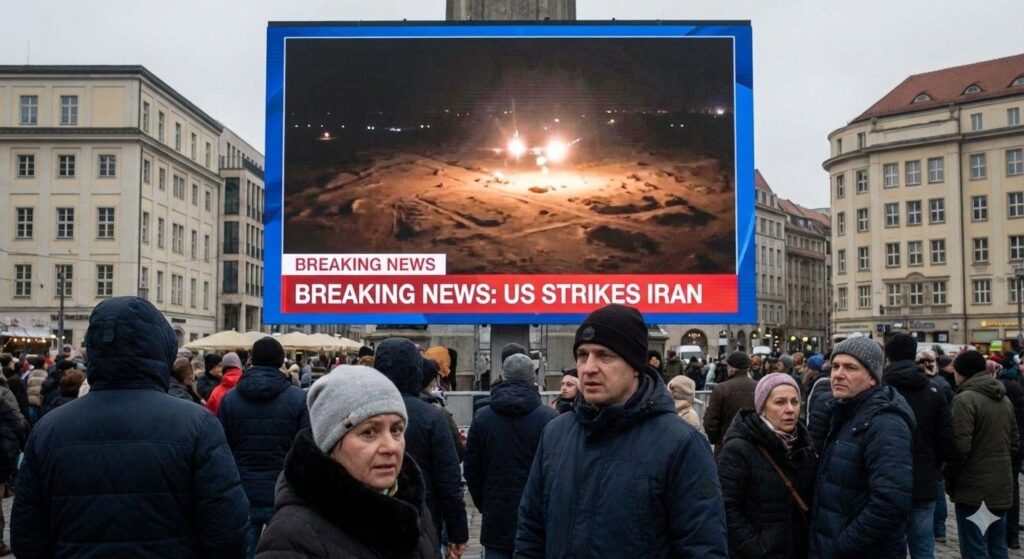
A US strike on Iran would trigger layered military, economic, and political consequences far beyond the battlefield
The idea of a US attack on Iran is often discussed as if it were a discrete event. A set of airstrikes. A clear objective. A limited timeline. In this framing, American military superiority ensures control, escalation is manageable, and the aftermath can be shaped through deterrence or diplomacy.
This is the story that resurfaces whenever tensions rise. It is also the story most likely to fail.
A US attack on Iran would not unfold as a short military episode. It would behave more like a system shock, rippling across the Middle East and into global markets, alliances, and political calculations in ways that cannot be neatly bounded.
The assumption of a clean strike
The belief in a clean operation rests on two assumptions. First, that Iran’s capabilities can be meaningfully degraded through precision strikes. Second, that Tehran would be deterred from broad retaliation by fear of an overwhelming American response. Both assumptions underestimate Iran’s power structure.
Iran does not rely on conventional force symmetry with the United States. Its strength lies in dispersion, redundancy, and indirect leverage. Military assets are spread across hardened and underground facilities. Command structures are designed to absorb disruption. Influence extends through networks rather than frontlines.
A strike may succeed tactically while failing strategically. That gap is where escalation begins.
Why the first strike would not define the conflict
Even a limited US attack would immediately raise the question of response. Iran’s leadership has repeatedly signalled that retaliation would not be symbolic. The form that retaliation takes matters more than its scale.
Rather than mirror US actions, Iran would likely activate pressure points across the region. American bases in the Gulf, allied infrastructure, and maritime routes would all become part of the contest. These are not hypothetical targets. They are deeply embedded in regional geography and commerce.
Once this happens, the conflict ceases to be bilateral. It becomes regional by default.
The Middle East as an escalation engine
The Middle East does not absorb shocks quietly. It amplifies them.
US forces are spread across multiple countries. Allies host bases that were never designed to function under sustained fire. Militias aligned with Iran operate within fragile political systems where escalation can collapse internal balances.
If the US attacks Iran, it would therefore force regional governments into uncomfortable positions. Some would be dragged into conflict despite efforts to remain neutral. Others would face domestic pressure as their territory becomes exposed.
This is how limited wars become regional crises without formal declarations.
The Strait of Hormuz problem
No analysis is complete without the Strait of Hormuz if the US attacks Iran. This narrow passage is not just a shipping lane. It is a pressure valve in the global economy.
Iran does not need to close the strait entirely to disrupt it. Even partial interference would raise insurance costs, slow shipping, and spike energy prices. Markets respond not to certainty, but to risk.
The mere perception that energy flows are vulnerable would ripple through inflation, monetary policy, and political stability far from the Gulf.
This is why even countries distant from the conflict would feel its impact.
What Washington would struggle to control
The United States would enter such a conflict with clear military advantages. It would not enter with clear political endpoints.
Degrading Iranian capabilities does not guarantee behavioural change. History suggests that external attacks often harden internal resolve rather than weaken it. In Iran’s case, external pressure has repeatedly strengthened hardline factions and narrowed the space for internal dissent.
A strike intended to coerce could end up consolidating the very forces it seeks to weaken.
The global reaction beyond the region
Outside the Middle East, reactions would be cautious rather than enthusiastic.
Major powers would publicly urge restraint while privately recalibrating their risk assessments. China would view escalation through the lens of energy security and regional stability. Europe would focus on economic spillovers and refugee risks. Emerging economies would worry about inflation and capital flight.
Few would see strategic upside. Many would see exposure. This matters because diplomatic isolation, not just military pressure, determines long-term outcomes.
Also Read: Trump Deploys “Armada” to Persian Gulf as Iran Deadline Looms
Markets move faster than diplomacy
Financial markets would not wait for clarity.
Oil prices would react immediately. Shipping and insurance costs would rise. Supply chains already strained by geopolitical uncertainty would price in additional risk. Central banks would reassess inflation trajectories.
These reactions are not temporary. Once risk is priced in, it lingers. The economic aftershocks could outlast the military phase of the conflict if the US attacks Iran.
The domestic political feedback loop
In the United States, an attack on Iran would quickly intersect with domestic politics. Initial support often gives way to scrutiny as costs rise and timelines stretch. Public tolerance for prolonged conflict is low, especially when objectives are unclear.
In Iran, external attack would likely suppress internal divisions. National security narratives would dominate. Political space would contract. Rather than producing moderation, conflict would likely entrench positions on both sides.
Why the “quick win” narrative collapses
The idea of a decisive, contained strike assumes control over escalation, allies, markets, and domestic politics simultaneously. That level of control is rare.
Iran’s strategy is built around absorbing initial blows and extending the contest over time and space. The region’s structure amplifies spillover. The global economy magnifies risk.
Under these conditions, the question is not whether the United States can strike Iran. It is whether it can shape what follows.
What already behaves differently
Even the possibility if the US attacks Iran alters behaviour.
Regional states hedge their positions. Energy markets’ price volatility. Shipping routes adjust. Diplomacy becomes cautious and transactional.
These changes occur before a single missile is launched.
They reveal the central truth of this scenario. A US attack on Iran would not reset the balance of power. It would expose how little control any actor has once escalation begins.
The United States has the capacity to strike. It does not have the capacity to contain all the consequences. And in geopolitics, that distinction is often the one that matters most.