
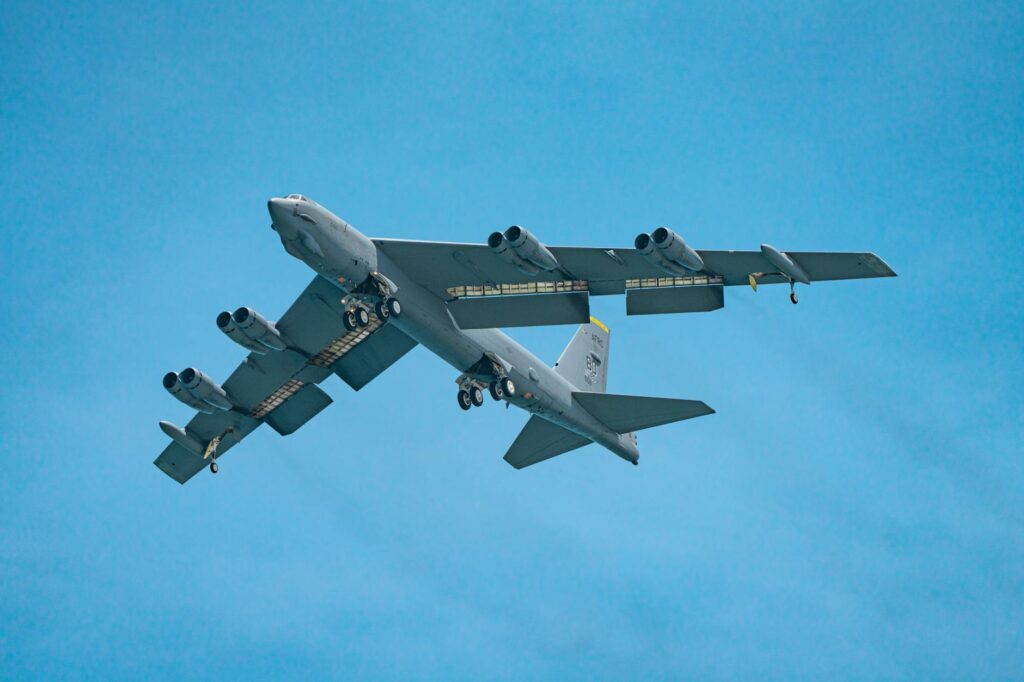
The US Air Force’s decision locks the B-52 into service for decades and reshapes how legacy platforms stay relevant
The US Air Force has awarded Boeing a contract worth roughly $2 billion to integrate new engines on its B-52 bomber fleet. The programme focuses on replacing eight ageing engines on each aircraft, a change that extends operational life while cutting maintenance strain.
This matters now because the B-52 engine replacement moves a 1960s-era bomber firmly into the mid-21st century. The decision reinforces a clear message: the platform is not being phased out but repositioned for long-term relevance.
Why the B-52 still matters
The B-52 Stratofortress remains a central part of US long-range strike capability. Although newer bombers exist, the aircraft offers payload flexibility, global reach, and proven reliability. As a result, the B-52 engine replacement becomes less about nostalgia and more about cost-effective power projection.
Also Read: New Players in the Sky: Govt Fast-Tracks Al Hind Air and FlyExpress to Challenge Duopoly
The US Air Force has repeatedly stated that the B-52 will serve into the 2050s. That timeline only works if propulsion, avionics, and sustainment are modernised together. The engine programme is the most consequential of those upgrades.
Timing and defence priorities
The timing of the B-52 engine replacement reflects broader shifts in defence planning. The US is balancing investments between next-generation platforms and upgrades to existing assets. At the same time, budget pressures demand systems that deliver longevity without spiralling costs.
By committing to this contract now, the Air Force reduces future uncertainty. Engine reliability improves sortie rates, while fuel efficiency lowers operating costs over decades. This approach aligns with a wider push to stabilise readiness rather than chase rapid replacement cycles.
Industrial and strategic implications
For Boeing, the contract reinforces its role as a systems integrator rather than just an aircraft builder. The B-52 engine replacement involves coordinating airframe modifications, engine integration, and long-term sustainment. That work anchors Boeing deeper into US defence infrastructure.
The engines themselves are supplied by Rolls-Royce, adding an allied industrial dimension. This collaboration highlights how modern defence programmes increasingly rely on transatlantic supply chains, even for core strategic assets.
Global relevance of the decision
Globally, the decision sends a signal about how major powers manage ageing but capable platforms. Instead of retiring them, the US is choosing selective modernisation. The B-52 engine replacement demonstrates how deterrence today depends as much on logistics and availability as on stealth or speed.
For allies and competitors alike, the message is clear. Legacy systems, when upgraded intelligently, can remain credible and adaptable in a contested environment.
The Hinge Point
The hinge point lies in what this contract makes unavoidable. Once the B-52 engine replacement is completed, the aircraft ceases to be a stopgap solution. It becomes a deliberately sustained pillar of US airpower.
This changes how future bomber investments are framed. The US Air Force no longer treats modernisation and replacement as parallel paths. Instead, it shows that extending proven platforms can be a strategic choice, not a compromise. That recalibration affects budgeting, force structure, and industrial planning.
What can no longer remain the same is the assumption that legacy systems fade quietly as new ones arrive. With this contract, the B-52 is formally repositioned as a long-term asset. The story shifts from preservation to strategic continuity, anchored by the B-52 engine replacement as its enabling core.