
A US strike on Iran would trigger layered military, economic, and political consequences far beyond the battlefield
Whenever geopolitical tensions rise, cryptocurrency is once again described as a refuge. A borderless asset. A hedge against state conflict. A system that exists outside war, sanctions, and sovereign control.
This narrative resurfaces precisely because it feels intuitive. If traditional systems fracture, decentralised ones should benefit. If banks freeze and borders close, digital assets should thrive. Yet history, market behaviour, and structure all suggest the opposite.
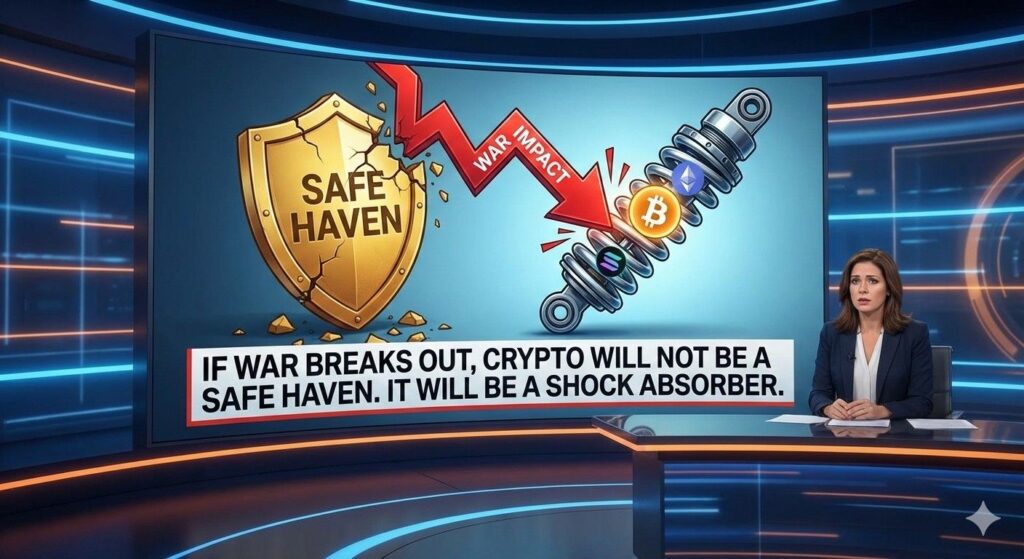
In a real war scenario, especially one involving the United States and Iran, cryptocurrency would not be immune to volatility. It would concentrate it.
The comforting myth of neutrality
Cryptocurrency is often framed as neutral infrastructure. Code without allegiance. Money without a flag. In theory, that neutrality should make it resilient when states clash.
In practice, markets do not reward neutrality. They respond to liquidity, risk appetite, and leverage. Crypto is deeply embedded in global financial sentiment, not insulated from it. It trades twenty-four hours a day, reacts instantly to news, and sits at the intersection of speculative capital, retail psychology, and leveraged instruments.
That makes it highly sensitive to shocks, not protected from them.
What war actually does to capital behaviour
When war breaks out, capital does not move calmly. It does not search for ideological purity. It seeks safety, liquidity, and familiarity.
In moments of acute uncertainty, investors reduce exposure to assets that lack clear valuation anchors or lender-of-last-resort support. They prefer instruments backed by states, even when states are the source of instability.
This is the first reason crypto volatility during war is unavoidable. Crypto has no stabilising authority. No central bank. No circuit breaker that reassures markets when panic accelerates.
In calm times, that is a feature. In crises, it is a vacuum.
Liquidity is the real fault line
Cryptocurrency markets are often described as deep and global. They are neither in moments of stress.
Liquidity in crypto is highly pro-cyclical. It expands during risk-on phases and evaporates during risk-off phases. Market makers pull back. Spreads widen. Order books thin. Small moves cascade into large price swings.
A war involving major powers would not just move prices. It would drain liquidity.
As traditional markets de-risk, leveraged crypto positions are unwound. Forced liquidations amplify moves. Volatility feeds on itself. This dynamic is mechanical, not psychological.
Why sanctions narratives mislead
Another common argument is that war, sanctions, and financial restrictions push demand toward crypto. This is partially true, but misleading at scale.
Crypto can function as a workaround for individuals and small flows. It does not absorb systemic capital flight without destabilising itself.
Large actors require liquidity, clarity in compliance, and price stability. War increases scrutiny, not tolerance. Exchanges face pressure. On-ramps tighten. Stablecoins come under regulatory focus.
The more geopolitically sensitive crypto becomes, the more it is pulled back into the orbit of state power. This paradox ensures volatility. Adoption rises in theory. Friction rises in practice.
The correlation problem no one escapes
During crises, correlations converge. Assets that appear uncorrelated in normal conditions begin to move together.
Crypto has repeatedly shown this behaviour. In periods of global stress, it trades less like digital gold and more like high-beta risk assets. When equities fall sharply, crypto often falls faster.
A US–Iran war would not break this pattern. It would reinforce it. Risk-off environments punish assets whose value depends on future belief rather than present utility. Crypto remains belief-heavy.
Energy, mining, and the physical world
War also disrupts the physical foundations of crypto.
Mining depends on energy markets. Energy markets would be among the first casualties of a Middle East conflict. Rising costs, supply uncertainty, and infrastructure risk directly affect network economics.
Hashrate fluctuations introduce further uncertainty. Transaction fees spike. Network stability becomes a topic of concern. Crypto may be digital, but it is not detached from physical systems.
The narrative lag worsens volatility
One reason crypto volatility during war feels extreme is narrative lag.
Markets move faster than explanations. By the time analysts debate whether crypto is a hedge, price action has already invalidated certainty. Conflicting narratives coexist. Traders position against each other. Volatility becomes the only stable outcome.
This is not confusion. It is information overload colliding with leverage.
Why volatility is structural, not temporary
The instinct is to treat war-driven volatility as episodic. A spike, a crash, a recovery. That underestimates how crypto is built.
Crypto combines three volatile elements. Continuous trading, fragmented regulation, and speculative dominance. War intensifies all three.
Continuous markets mean no pause for digestion. Fragmented regulation means uneven response. Speculative dominance means sentiment swings faster than fundamentals.
Together, they ensure that volatility during war is not an unintended consequence. It is the core behaviour.
Also Read: America Is Still Powerful. Its Commitments Are No Longer Assumed
What does not happen, despite expectations
Crypto does not decouple cleanly. It does not stabilise quickly. It does not become a universal refuge. Instead, it becomes a live stress test of global risk appetite.
Some participants may use it out of necessity. Others may flee it out of fear. Both actions increase instability.
What already behaves differently when war is possible
Even the prospect of war changes crypto markets.
Derivatives volumes rise. Funding rates swing. Stablecoin demand fluctuates sharply. Liquidity migrates between venues.
These shifts happen before conflict begins. They show that crypto volatility during war is anticipated, not accidental.
The uncomfortable conclusion
Cryptocurrency was designed to operate without trust in institutions. It was not designed to operate without trust in stability itself. War removes that stability.
In such moments, crypto does not escape the system. It reflects it, magnifies it, and accelerates its stress signals.
That does not make crypto irrelevant. It makes it honest.
In a world sliding toward geopolitical fracture, cryptocurrency will not be calm. It will be volatile because the world is volatile. And there is no protocol upgrade that fixes that.