
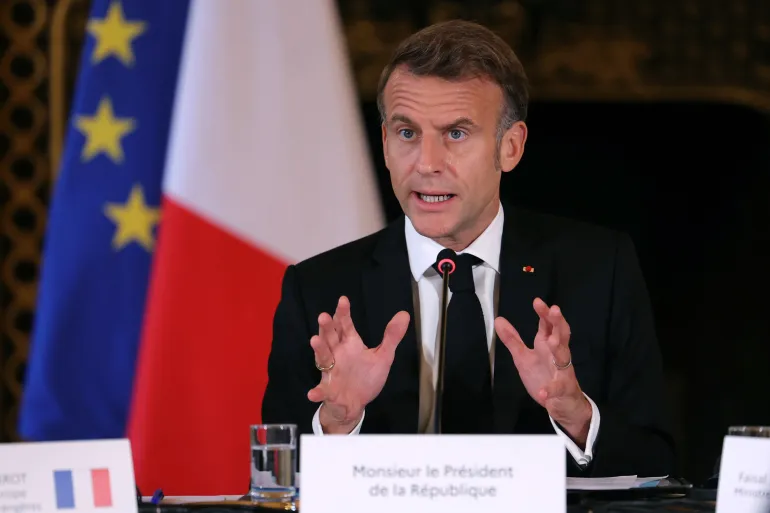
French President Emmanuel Macron is leading a push for the European Union to activate its most powerful economic weapon
French President Emmanuel Macron has formally requested that the European Union activate its most potent trade weapon to counter escalating economic pressure from the United States. The move follows a weekend of high-stakes diplomacy after President Donald Trump threatened a 25 per cent tariff on eight European nations. These levies are explicitly linked to a demand for the purchase of Greenland, an autonomous territory of Denmark, which European leaders have called a clear act of economic intimidation.
The request to trigger the Anti-Coercion Instrument represents a dramatic escalation in transatlantic relations. While the European Union has spent years developing this “trade bazooka” to protect its sovereignty, it has never been deployed against a major ally. France argues that the blatant use of trade duties to force a territorial sale leaves the bloc with no choice but to demonstrate its collective economic strength.
The mechanics of Europe’s trade bazooka
The Anti-Coercion Instrument is a legislative tool that allows the European Commission to respond to third countries that use economic measures to influence the bloc’s sovereign choices. Unlike standard retaliatory tariffs, this mechanism allows for a broad range of countermeasures. These can include restrictions on services, limits on public procurement, and the suspension of intellectual property protections.
Also Read: Greenland Rejects Trump’s Takeover Talk as Arctic Security Enters a New Phase
By targeting sectors where the United States maintains a significant surplus, such as digital services and technology, France believes the bloc can create meaningful leverage. However, the use of the Anti-Coercion Instrument requires a qualified majority of member states. This means at least 15 countries representing 65 per cent of the EU population must approve the findings of an investigation into the alleged coercion.
A geopolitical rift over Arctic sovereignty
The tension began when several European nations, including France and Germany, deployed military personnel to Greenland to enhance Arctic security. President Trump interpreted this move as an obstruction to his long-stated goal of acquiring the island for its strategic mineral wealth and missile defence potential. The resulting tariff threat targets Denmark, France, Germany, the UK, Finland, the Netherlands, Norway, and Sweden.
European leaders have stood in solidarity with Denmark, asserting that Greenland is not for sale. The push to use the Anti-Coercion Instrument is rooted in the belief that the international rules-based order is under direct assault. By linking trade policy to territorial acquisition, the White House has crossed a line that European diplomats previously thought was reserved for historical land disputes.
Fragmentation within the European response
Despite Paris’s firm stance, the European Union remains divided over whether to pull the trigger. Some member states, particularly those with deep manufacturing ties to the American market, fear that activating the Anti-Coercion Instrument will only invite further retaliation. There is a deep-seated worry that a full-scale trade war could derail the Eurozone’s fragile economic recovery.
While the European Parliament has already signalled its intent to freeze existing trade agreements with Washington, the Commission is proceeding with caution. Diplomats in Brussels are currently weighing a phased approach that might involve reviving a suspended 93 billion-euro tariff package before resorting to the more aggressive measures in the new instrument.
The Hinge Point
The push for the Anti-Coercion Instrument marks the exact moment when the European Union must decide if it is a global power or merely a large market. This is the hinge point because the “Greenland threat” is the first time the bloc’s sovereignty has been challenged not through military force, but through the weaponisation of its own economic integration. The story changes here because the myth of a “siloed” trade relationship is dead; trade is now officially a sub-department of territorial security.
If the EU fails to act, the Anti-Coercion Instrument will be exposed as a paper tiger, and the bloc will effectively accept that its internal borders are subject to external pressure. If it does act, the decades-old transatlantic alliance will shift from a partnership of shared values to a cold peace defined by mutual economic deterrence. This is no longer a dispute about lobster or steel; it is a fundamental test of whether a 21st-century democracy can resist 19th-century expansionism using 22nd-century trade laws.