
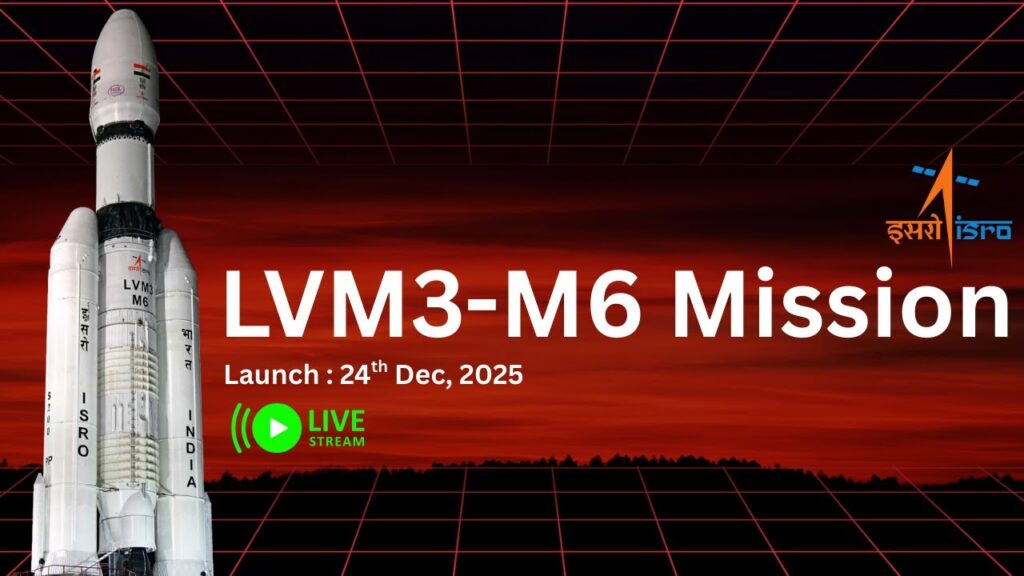
India’s heaviest launcher flies again, strengthening strategic autonomy and signalling a new phase in space capability
Indian Space Research Organisation conducted the LVM3-M6 mission, deploying a high-mass payload using its heavy-lift launch vehicle. The launch followed a string of operational successes, therefore reinforcing confidence in India’s most powerful rocket.
However, this flight matters beyond another successful launch. The LVM3-M6 mission consolidates a capability that sits at the core of India’s long-term space plans, including human spaceflight and deep-space missions.
Background of the LVM3 programme
The LVM3 rocket was designed to place heavy payloads into orbit, unlike earlier launch vehicles optimised for lighter satellites. As a result, it became central to India’s ambition to move from routine launches to complex, strategic missions.
Over time, incremental upgrades improved reliability and payload capacity. Therefore, each mission now serves as both a deployment exercise and a systems validation for future programmes.
Timing and strategic context
The LVM3-M6 mission comes at a moment when global space activity is intensifying. Meanwhile, national space agencies are prioritising assured access to orbit over dependence on foreign launch services.
For India, timing is critical. As human spaceflight preparations accelerate, the LVM3-M6 mission demonstrates readiness at a phase when programme delays would have carried high strategic costs.
Also Read: ISRO Gears Up for Historic Blitz with Seven Major Launches by March 2026
Implications for India’s space roadmap
Because the LVM3 is the backbone of upcoming crewed missions, operational confidence has direct consequences. Therefore, a stable launch record reduces risk across multiple downstream programmes.
Moreover, the LVM3-M6 mission strengthens India’s credibility as a provider of heavy-lift services. Although commercial exploitation is not its primary goal, strategic reliability often precedes market relevance.
Global and systemic relevance
Globally, heavy-lift launch vehicles define who can execute independent space agendas. Consequently, the LVM3-M6 mission positions India among a small group of nations with proven heavy-lift capability.
At a systemic level, this capability alters planning assumptions. Mission architectures, satellite design, and international partnerships now factor in India as a dependable launch option rather than a peripheral player.
The Hinge Point
The LVM3-M6 mission marks the moment when India’s heavy-lift programme moves from developmental validation to operational inevitability. After this launch, the question is no longer whether the LVM3 can deliver consistently. The question shifts to how this assured capability reshapes national priorities.
This is the point where timelines compress. Human spaceflight planning now proceeds without structural uncertainty. Deep-space ambitions gain practical grounding. Strategic autonomy in access to space becomes an operational fact rather than a policy aspiration.
What cannot remain the same is India’s cautious positioning in global space conversations. With the LVM3-M6 mission, India crosses from capability demonstration to capability ownership. That transition changes expectations, partnerships, and accountability across the entire space ecosystem.