
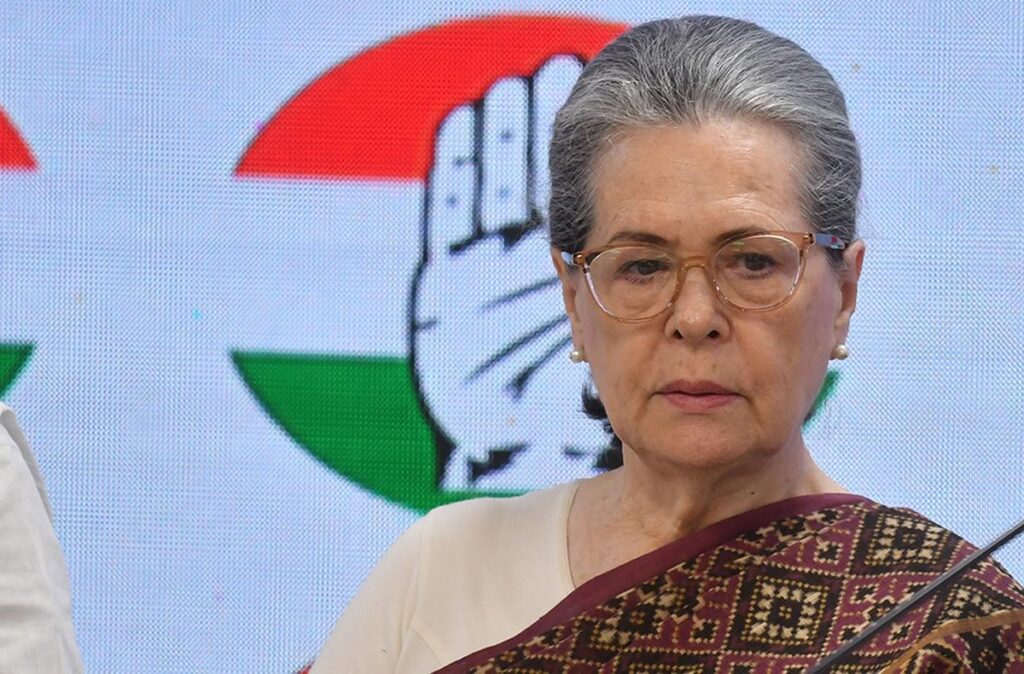
Congress leader Sonia Gandhi alleges systematic dilution of MGNREGA and signals a renewed political and legal fight
Senior Congress leader Sonia Gandhi has launched a sharp attack on the Modi Government, accusing it of bulldozing the MGNREGA law and undermining the spirit of India’s flagship rural employment programme. Speaking on the issue, she described the current changes as a black law in effect and said Congress would fight what it sees as a systematic erosion of workers’ rights.
Her remarks have once again brought the Mahatma Gandhi National Rural Employment Guarantee Act to the centre of political debate. At a time when rural distress and uneven income recovery continue to draw concern, the future of the MGNREGA law is emerging as a key fault line between the government and the opposition.
Also Read: VB G RAM G Bill set to replace MGNREGA, signals major reset in rural employment policy
Allegations of dilution and exclusion
Sonia Gandhi’s criticism focuses on what the Congress describes as administrative and budgetary decisions that have weakened the MGNREGA law without formally repealing it. According to her, changes in wage payments, delayed fund releases and stricter compliance norms have reduced access to guaranteed work for rural households.
She argued that the law was designed as a rights-based safety net. However, she claimed that its implementation now reflects a shift towards control rather than support. As a result, she said, vulnerable workers face uncertainty despite rising demand for employment under the scheme.
Government defence and political pushback
The government has consistently rejected allegations that it has weakened the MGNREGA law. It maintains that reforms aim to improve transparency, curb leakages and ensure that benefits reach genuine beneficiaries. Officials have also pointed to record registrations and higher allocations in certain years as proof of commitment.
Even so, the political narrative has sharpened. The Indian National Congress views the issue as emblematic of a broader policy approach that prioritises fiscal discipline over social protection. Meanwhile, the Bharatiya Janata Party argues that governance reforms are necessary to sustain welfare schemes.
Why MGNREGA still matters
The relevance of the MGNREGA law extends beyond party politics. Since its enactment, the scheme has acted as a countercyclical buffer during economic slowdowns, including the pandemic years. Economists often cite it as a crucial source of rural income support, especially when private sector jobs weaken.
Therefore, any perceived dilution of the MGNREGA law carries economic and political implications. Reduced effectiveness could increase rural distress, intensify migration pressures and widen regional inequalities. On the other hand, improved execution could strengthen local demand and stabilise rural economies.
What lies ahead for the law
Sonia Gandhi has indicated that the Congress will raise the issue both inside and outside Parliament of India. This suggests that debates around the MGNREGA law may intensify in upcoming sessions, with demands for greater accountability and statutory guarantees.
Policy watchers expect continued scrutiny of funding patterns, wage revisions and payment timelines. States may also play a larger role, as many have already flagged concerns about delayed reimbursements and administrative bottlenecks.
The Hinge Point
What remains under discussed is how the current debate could reshape the long-term architecture of social welfare in India. The MGNREGA law is not just another scheme. It represents a legislative commitment that links employment to dignity and citizenship.
If political contestation leads to clearer standards on funding predictability and wage indexation, the law could emerge stronger. However, if administrative tightening continues without parallel safeguards, the programme risks becoming narrower in scope despite rising demand.
In that sense, Sonia Gandhi’s intervention marks a hinge point. The future of the MGNREGA law will signal whether India chooses to reinforce rights-based welfare or gradually redefine it through executive control. That choice will have consequences well beyond this single programme.