
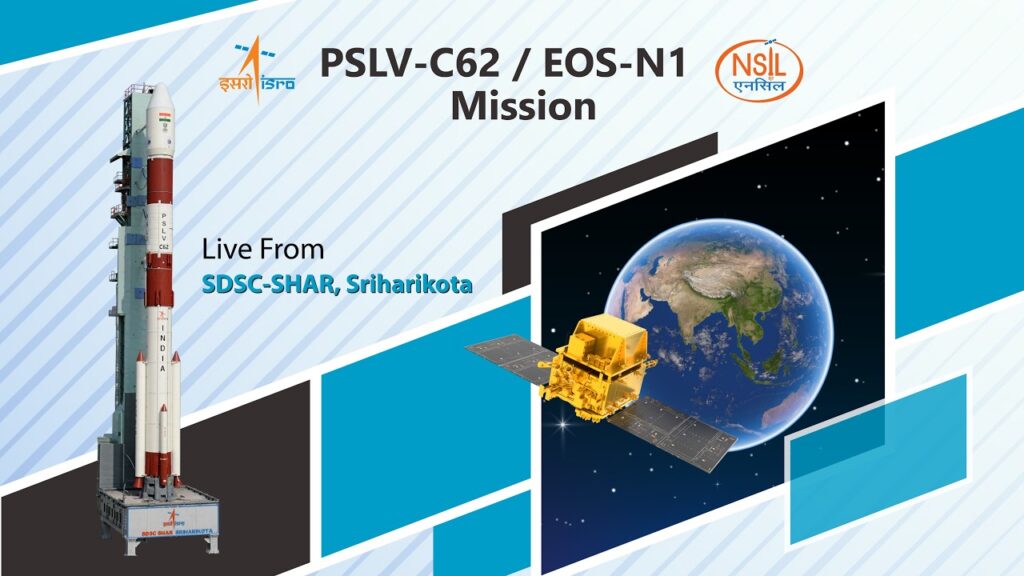
Indian Space Research Organisation reports anomaly at PS3 stage, triggering detailed analysis of PSLV-C62 flight
The PSLV-C62 mission anomaly unfolded during the final moments of the PS3 stage, just as the EOS-N1 satellite was expected to be placed on a precise low Earth orbit. While the rocket performed normally through earlier phases, telemetry later confirmed that the third stage did not achieve its planned burn profile.
Because of that PSLV-C62 mission anomaly, EOS-N1 failed to reach its intended orbit. As a result, a satellite meant to strengthen India’s Earth observation capacity has not entered operational service, and ISRO now has to examine what went wrong inside one of its most trusted launch vehicles.
Background of the EOS-N1 launch
EOS-N1 was designed as part of India’s growing Earth observation fleet, which supports agriculture, urban planning, disaster management, and national security. These satellites provide frequent, high-resolution images that government agencies and private users depend on. Therefore, every launch in this series carries both operational and strategic weight.
Although PSLV has built a reputation for reliability, the PSLV-C62 mission anomaly reminds engineers that even mature launch systems demand constant validation. Since the PSLV family has flown dozens of times, each mission also serves as a data point that protects future launches.
Also Read: ISRO’s LVM3-M6 Mission Marks a Shift in India’s Heavy-Lift Ambitions
Why the timing of this failure matters
This PSLV-C62 mission anomaly comes at a moment when India is expanding both its civil and commercial space programmes. On one hand, ISRO is preparing for human spaceflight and heavier rockets. On the other hand, it is also marketing PSLV to global satellite operators who need affordable and dependable launches.
Because EOS-N1 was meant to refresh India’s imaging capability, the timing matters. Several older satellites are nearing the end of their service life. Therefore, a gap in new deployments places pressure on data continuity, even though ground teams still rely on existing spacecraft.
What the PS3 stage tells engineers
The PS3 stage is a solid motor that provides the final push needed to fine-tune orbital insertion. When the PSLV-C62 mission anomaly occurred here, it suggested a deviation in thrust or burn duration. Since earlier stages performed as expected, attention now centres on ignition, propellant behaviour, and onboard control during this critical window.
ISRO has not released detailed numbers, and until it does, precise fault identification is not possible. However, engineers routinely analyse telemetry to isolate even small deviations, and that process now drives the entire investigation.
Implications for India’s satellite roadmap
Because of the PSLV-C62 mission anomaly, EOS-N1 will not contribute to India’s remote sensing network. That means planners must adjust tasking across existing satellites to cover the same ground. While that is possible in the short term, it stretches assets that were not designed for extra load.
At the same time, the anomaly forces ISRO to pause and review before the next PSLV flight. Although this slows the launch calendar, it also protects downstream missions from repeating the same fault. Therefore, the immediate disruption supports long-term stability.
Global confidence in India’s launch services
India has positioned PSLV as a workhorse for small and medium satellites worldwide. Clients choose it for cost, schedule certainty, and a strong track record. When a PSLV-C62 mission anomaly becomes public, international partners naturally watch how quickly and transparently the issue is addressed.
However, a single anomaly does not erase decades of performance. What matters instead is how ISRO documents the root cause and demonstrates corrective action on the next launch.
The Hinge Point
The PSLV-C62 mission anomaly changes the story by challenging the assumption that this launch vehicle operates on autopilot. For years, PSLV’s consistency allowed India to scale Earth observation, serve foreign customers, and plan missions with minimal contingency. Now, that certainty has shifted.
From this point onward, every upcoming PSLV flight carries a new burden of proof. Engineers must show that the PS3 stage issue is fully understood, fixed, and verified. Satellite planners, both domestic and international, will factor this episode into schedules and risk assessments. In practical terms, India’s space programme moves from routine execution back into active validation.
That shift matters because space operations depend on confidence more than headlines. Once a trusted system shows a flaw, the entire pipeline from satellite design to data delivery adjusts. The EOS-N1 shortfall, therefore, is not just about one lost spacecraft. It signals a reset in how ISRO and its partners measure readiness, discipline, and accountability across every launch that follows.