
India’s finance minister says oil’s recent surge will not feed through to consumer prices. The claim rests on specific buffers and specific risks
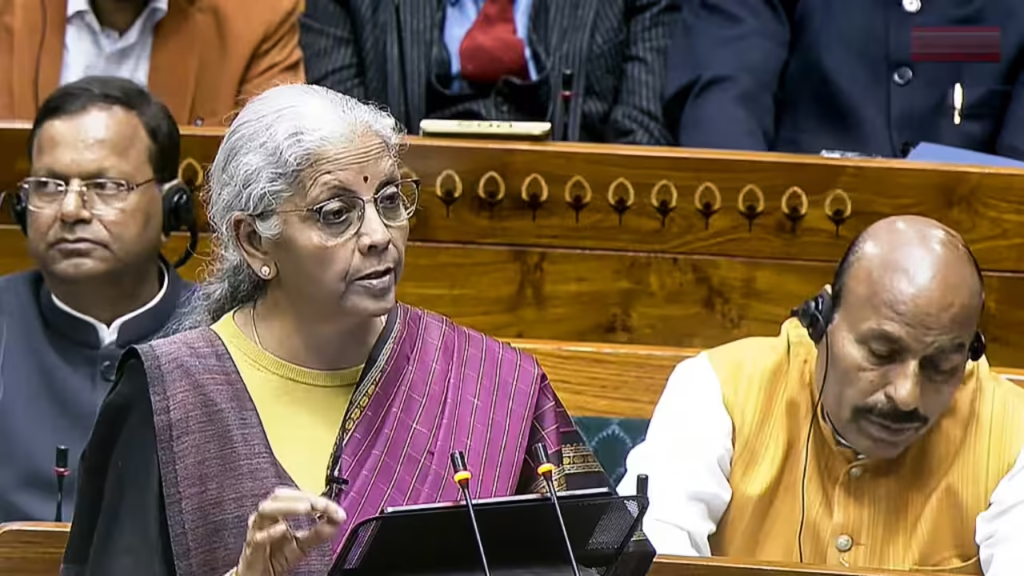
Finance Minister Nirmala Sitharaman stated this week that the recent surge in global crude prices will not produce any substantial effect on domestic inflation. She grounded this position in India’s existing fiscal architecture: managed fuel retail prices, strategic reserve buffers, and the relative insulation of food and core indices from energy pass-through at current levels.
The statement carries weight precisely because it was made without qualification. Sitharaman did not hedge around supply chain volatility or global demand projections. She chose the language of settled assessment, not cautious forecast. That choice, in itself, tells you something about the government’s current confidence in its inflation management toolkit.
The Buffer Architecture India Is Relying On
India does not allow retail fuel prices to move in real time with global crude. State-owned oil marketing companies absorb differential margins during price surges, with the government periodically adjusting excise duties to redistribute the burden. This mechanism has functioned as India’s primary shock absorber through multiple crude cycles.
Consequently, the transmission from Brent crude to the Consumer Price Index in India is slower and more attenuated than in economies with liberalised fuel pricing. The government calculates that the current surge, unless it sustains well beyond present levels, falls within the absorptive capacity of this system.
Also Read: India and Canada Reset Ties With a Landmark Nuclear Deal
Why the Timing of This Statement Matters
Global crude prices have firmed on the back of OPEC+ supply discipline and renewed demand signals from China. Meanwhile, India is approaching a period of elevated fiscal sensitivity: state elections are either underway or scheduled in several major states, and the Union Budget cycle is entering its pre-planning phase.
Therefore, a finance minister affirming price stability is not merely an economic signal. It functions simultaneously as a political stabiliser. However, that dual function does not make the underlying economic argument wrong; it simply means the statement serves more than one audience.
Notably, India’s headline CPI has shown relative moderation in recent months, with food prices the dominant component, moving on domestic agricultural dynamics rather than energy inputs.
Where the Risk Remains Visible
Specifically, the risk that Sitharaman’s assessment does not account for is in secondary transmission. Crude oil inflation affects work through freight costs, agricultural input prices, and manufacturing energy costs, channels that do not appear immediately in the headline CPI but accumulate over two to three quarters.
Significantly, the oil marketing companies currently absorbing margin pressure will eventually require either excise relief or retail price revision. Neither option is cost-free. The first reduces government revenue; the second passes the load directly to consumers.
Also Read: India’s GST Mop-Up Hits Rs 1.83 Lakh Crore in February
The Hinge Point
The government’s position is technically defensible at the current crude price band. However, the inflation impact of crude oil becomes structurally difficult to contain if prices remain above current levels through the monsoon quarter, when food and fuel pressures can compound rather than offset. Sitharaman’s statement is accurate for now. The fiscal architecture that makes it accurate has a ceiling — and the market already knows roughly where that ceiling sits.