
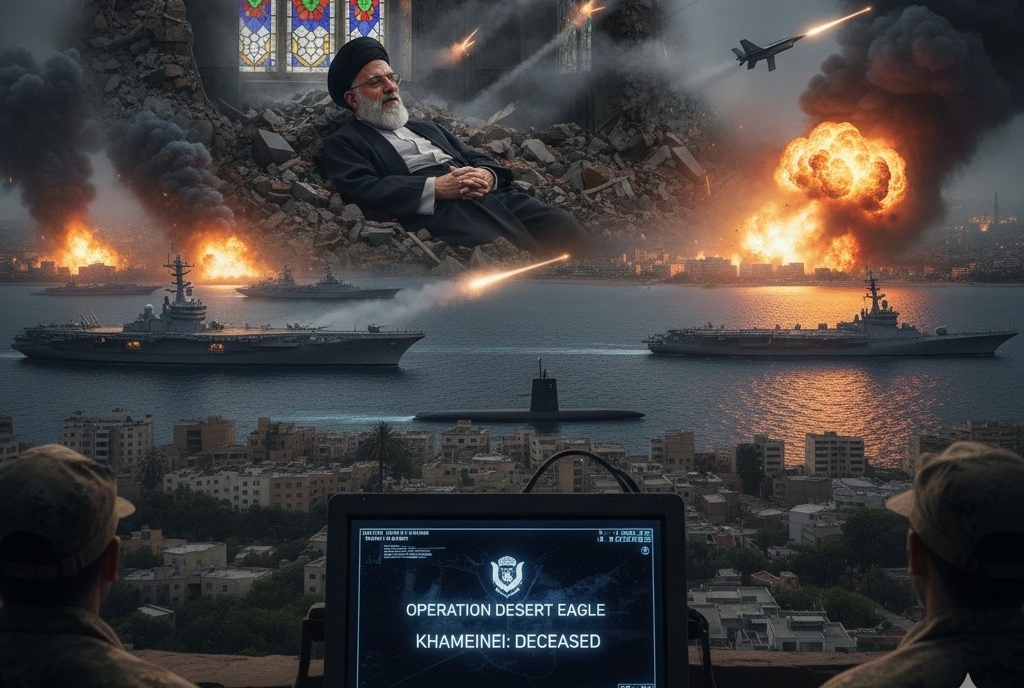
From Eisenhower’s coup to Operation Midnight Hammer, how seven decades of miscalculation produced this moment
The dominant framing of American strikes on Iran treats each episode as a reaction, a surgical response to Iranian provocation. This framing is wrong, not because Iran is blameless, but because it strips seventy years of American strategic choice from the story. Every military exchange between Washington and Tehran is presented as a discrete event. Collectively, however, they form a continuous arc of policy built on assumptions that have repeatedly collapsed.
The standard narrative also erases the Iranian state’s internal logic. Tehran’s behaviour is not random hostility. It is the output of a regime that has concluded, with considerable evidence, that the United States wants its elimination and that the only deterrent is the credible capacity to inflict unacceptable cost. Understanding the US-Iran conflict requires sitting with that conclusion, even when one rejects it.
What this explainer delivers is the mechanism beneath the timeline, the specific moments when the rules of engagement shifted, who benefited from each shift, and what the current escalation structurally cannot achieve.
Also Read: Iran Strikes US Bases Across the Gulf After Khamenei’s Death
1953 and the Original Fracture
The US-Iran conflict begins not with the 1979 revolution but with the CIA-backed coup of August 1953, which removed the elected Prime Minister Mohammad Mosaddegh and reinstated Shah Mohammad Reza Pahlavi. Operation AJAX, run jointly with British intelligence, was a response to Mosaddegh’s nationalisation of Iranian oil, then controlled by the Anglo-Iranian Oil Company, now British Petroleum.
Consequently, the foundational Iranian grievance is not theological but sovereign. The revolution of 1979 carried an enormous religious character, but its political fuel was the memory of a democratic government dismantled by foreign powers to protect oil revenue. This distinction matters because it explains why reformist governments inside Iran have never been able to fully normalise relations with Washington: the hardliners hold the institutional memory, and that memory is accurate.
The Hostage Crisis Locks the Template
When students seized the US Embassy in Tehran in November 1979, holding 52 Americans for 444 days, Washington’s domestic politics calcified against Iran permanently. The failed rescue operation, Eagle Claw, in April 1980, killed eight American servicemen in a desert accident and ended Jimmy Carter’s presidency as a functional enterprise.
Significantly, this failure produced a template that has governed American policy ever since: maximum pressure through sanctions, support for Iran’s regional adversaries, and periodic direct action. Ronald Reagan subsequently sold weapons to Iran during the Iran-Contra affair while simultaneously supporting Saddam Hussein’s Iraq in its eight-year war against Tehran. The US-Iran conflict, even then, was never a simple binary.
The Tanker War and the USS Vincennes
Between 1984 and 1988, the United States Navy conducted Operation Earnest Will, escorting Kuwaiti oil tankers through the Gulf as Iranian forces targeted shipping. In July 1988, the USS Vincennes shot down Iran Air Flight 655, killing all 290 passengers and crew. Washington offered compensation but never an apology.
Therefore, from Tehran’s vantage, the United States had entered a war against Iran, supported its enemies, and then killed nearly 300 Iranian civilians with legal impunity. The reflex to develop asymmetric capabilities, including support for proxy militias across the region, accelerates from this point. The Vincennes incident is the least discussed and most consequential episode in the entire US-Iran conflict.
Also Read: Russia-Ukraine Talks in UAE Conclude Without Breakthrough
The Nuclear Programme as Strategic Insurance
Iran’s nuclear programme did not begin as a weapons project. It started in 1957 under the Shah, with American support. However, after 1979, the programme acquired a different character. By the early 2000s, the IAEA confirmed that Iran was enriching uranium beyond civilian energy requirements.
The George W. Bush administration’s invasion of Iraq in 2003 accelerated Iranian nuclear ambitions in a specific way. Washington had just destroyed a secular Arab government that had no nuclear weapons. North Korea, which did have a nuclear deterrent, faced no invasion. Iranian policymakers drew the obvious conclusion. Notably, the 2015 Joint Comprehensive Plan of Action, the JCPOA, capped Iranian enrichment at 3.67% and reduced its uranium stockpile by 98% in exchange for sanctions relief. It was the one moment in the US-Iran conflict when the mechanism of escalation was interrupted.
Trump Exits JCPOA, Iran Responds Incrementally
Donald Trump withdrew the United States from the JCPOA in May 2018, reimposing sanctions and adding new ones under a “maximum pressure” doctrine. The Iranian response was not immediate and dramatic. It was gradual and calculated. By 2019, Iran had resumed enrichment beyond JCPOA limits, reaching 60% purity, then 84%, approaching weapons-grade threshold.
In January 2020, a US drone strike at Baghdad International Airport killed IRGC Quds Force commander Qasem Soleimani. Iran’s ballistic missile retaliation against Al-Asad airbase in Iraq injured over 100 American troops, though Washington initially claimed no casualties. Consequently, the US-Iran conflict entered a phase of direct military exchange that previous administrations had carefully avoided.
Also Read: Trump Warns of Higher Tariffs for Nations That “Play Games”
Operation Midnight Hammer and the 2025 Escalation
In June 2025, the United States conducted Operation Midnight Hammer, a large-scale strike campaign targeting Iranian nuclear facilities, including Fordow, Natanz, and Isfahan. The operation involved B-2 stealth bombers deploying Massive Ordnance Penetrator bunker-busters, a weapon designed specifically for hardened underground sites.
Fordow is buried under approximately 80 metres of mountain rock. The Pentagon assessed that the strikes set back Iranian enrichment capacity by one to two years. However, Iran’s nuclear knowledge base, its scientists, its engineering cadre, and its documented expertise remain entirely intact. Specifically, the strikes destroyed infrastructure, not capability.
Who Bears the Cost of Escalation
The calculation of winners in this phase of the US-Iran conflict is grimmer than most coverage acknowledges. Saudi Arabia gains a temporarily weakened rival. Israel removes a near-term nuclear threat but creates longer-term legitimacy for Iranian weaponisation. American defence contractors, specifically Northrop Grumman, which manufactures the B-21 Raider, and Boeing, which produces the GBU-57 penetrator, receive direct validation of their systems.
Iran’s civilian population bears the highest cost. Sanctions introduced under maximum pressure drove Iranian inflation to over 40% annually by 2023. The rial lost over 80% of its value against the dollar between 2018 and 2024. Meanwhile, IRGC commanders and the supreme leadership face no personal economic consequences. Therefore, maximum pressure has primarily served as a tool of civilian suffering rather than as a means of regime behaviour change.
The Proliferation Logic No One Is Discussing
Here is the structural problem that the current escalation creates and that most coverage has avoided stating plainly. Every non-nuclear state watching the US-Iran conflict now has data. States that gave up nuclear programmes (Libya, Iraq) were invaded or destabilised. States that maintained programmes (North Korea) were left alone. Iran, which suspended and negotiated, saw the agreement torn up unilaterally.
The logical policy conclusion for any state that perceives itself as an American adversary is accelerated, hidden nuclear development with no negotiation. Consequently, Operation Midnight Hammer may produce fewer Iranian centrifuges in 2026 while generating more nuclear programmes globally by 2030. Saudi Arabia has already signalled interest in enrichment capacity. Turkey has raised the question publicly.
Where the Trajectory Points
The US-Iran conflict has a structural resolution and a likely outcome. The structural resolution is a durable agreement that addresses Iranian security concerns and American non-proliferation goals simultaneously, similar to the JCPOA architecture but with stronger verification and longer timelines. This resolution requires American administrations to treat Iranian sovereignty as a real variable and Iranian administrations to accept verifiable constraints.
The likely outcome is different. Tehran rebuilds and disperses its enrichment infrastructure over the next three years, moving to smaller, deeper sites that penetration-capable munitions cannot reliably destroy. Iran accelerates militia coordination across Iraq, Syria, Yemen, and Lebanon, not as a direct military threat but as a friction cost against American and allied interests. A new negotiation eventually opens, probably after an Iranian enrichment breakthrough forces the conversation.
Significantly, the United States has conducted this cycle before: strike, degradation, rebuild, negotiate. The US-Iran conflict has never been resolved by force, and the mechanism of force has never changed that fact. What changes, each cycle, is the baseline from which the next round of diplomacy begins, and that baseline is now considerably more dangerous than it was in 2015.