
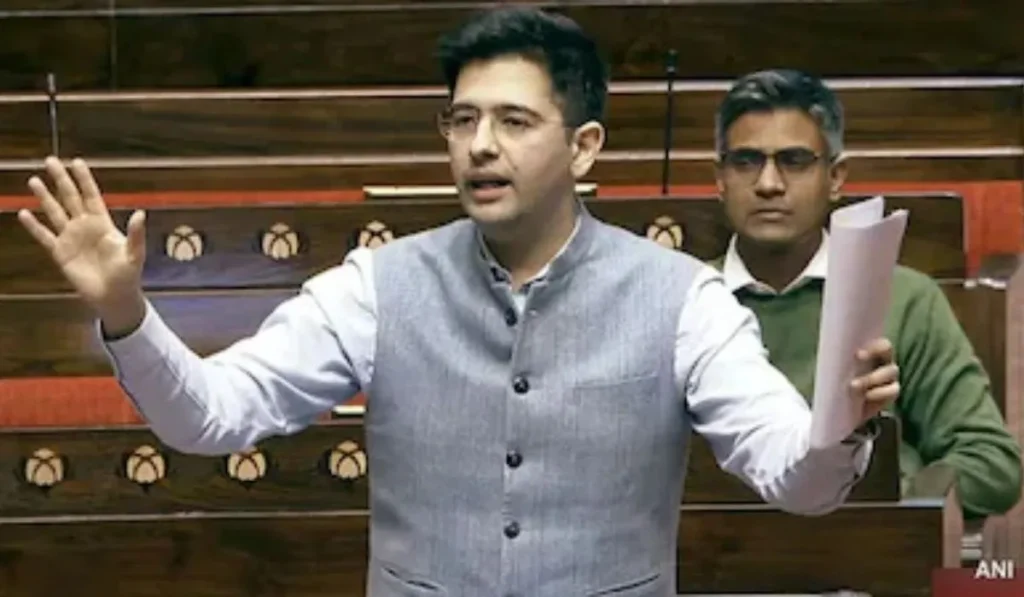
A speaking ban alongside the demotion signals containment, not a reshuffle
The Aam Aadmi Party removed Raghav Chadha as its deputy leader in the Rajya Sabha on 2 April 2026, replacing him with Ashok Mittal, a Punjab MP and founder of Lovely Professional University. The party wrote to the Rajya Sabha Secretariat, formalising the change. That letter carried an additional instruction: Chadha was not to be allotted speaking time from the AAP’s parliamentary quota.
Raghav Chadha AAP’s relationship has fractured in plain sight, and this move names it without naming it. Stripping a sitting MP of speaking time within his own party’s parliamentary bloc is not administrative tidying. It is a documented, institutional silencing.
The Architecture of Distancing
The removal did not arrive without precedent. Over the past two years, Chadha’s presence at defining party moments had thinned steadily. He was absent from Arvind Kejriwal’s road show following the Delhi court’s acquittal in the excise policy case in February 2026. He skipped a high-profile press conference at AAP headquarters and a Jan Sabha at Jantar Mantar. When Kejriwal was in judicial custody during the liquor case, Chadha neither held public solidarity events nor amplified the party’s messaging with any urgency. He was not among the legislators handed key portfolios during that period. The party’s exclusion of Chadha from its list of star campaigners for the upcoming Assembly elections preceded this formal demotion.
Also Read: Finance Bill 2026 Clears Lok Sabha With 32 Amendments
Why the Timing Holds
AAP emerged from the 2025 Delhi Assembly elections weakened, its urban base contested, its national ambitions recalibrated. Consequently, internal discipline has tightened around Kejriwal’s centrality. Meanwhile, Chadha had been gaining visibility through parliamentary interventions on gig workers’ rights, airport food pricing, and the tax burden on the middle class. These were not party-line positions; they were individual initiatives. Notably, his decision to spend a day working as a delivery partner drew national media attention with no reference to AAP’s broader political campaign. That kind of autonomous brand-building, however civic-minded, sits uneasily inside a party architecture built on a single personality.
The Cost of Visibility Without Permission
Chadha responded to his removal with a video statement. He said he had been silenced but not defeated, questioned the legitimacy of withdrawing a public representative’s speaking rights, and framed his parliamentary work as serving ordinary citizens. Significantly, he did not dispute the decision through party channels or invoke internal grievance mechanisms. His response was directed outward, at a public audience. AAP, in turn, had its representatives describe the change as routine. Ashok Mittal called it a normal process in which everyone deserves a turn.
The Hinge Point
The detail that separates this from ordinary reshuffling is the speaking ban. Removing someone from a titular post can plausibly be framed as a rotation. Instructing the Rajya Sabha Secretariat to withhold that person’s allotted floor time from the party’s quota is a separate act entirely. It reduces Chadha’s legislative function to attendance. AAP built its identity on giving ordinary voices institutional space; that was the founding argument of the Jan Lokpal movement and the party’s early parliamentary conduct. Raghav Chadha AAP now illustrates the distance the party has travelled from that argument. A leader who raised mobile data prices, gig worker protections, and airport food costs has been removed not for disloyalty but for independence. The elevation of Ashok Mittal, a low-profile figure with no comparable parliamentary record, confirms the preference: predictability over prominence. Personality-driven parties do not merely centralise power; they periodically demonstrate that centralisation by making visible examples of those who accumulate influence outside the centre’s orbit. Raghav Chadha, AAP’s Rajya Sabha chapter, has not ended, but its terms have been rewritten entirely by one side of the relationship.