
Behind the social media posts and warship deployments lies a coercive architecture decades in the making
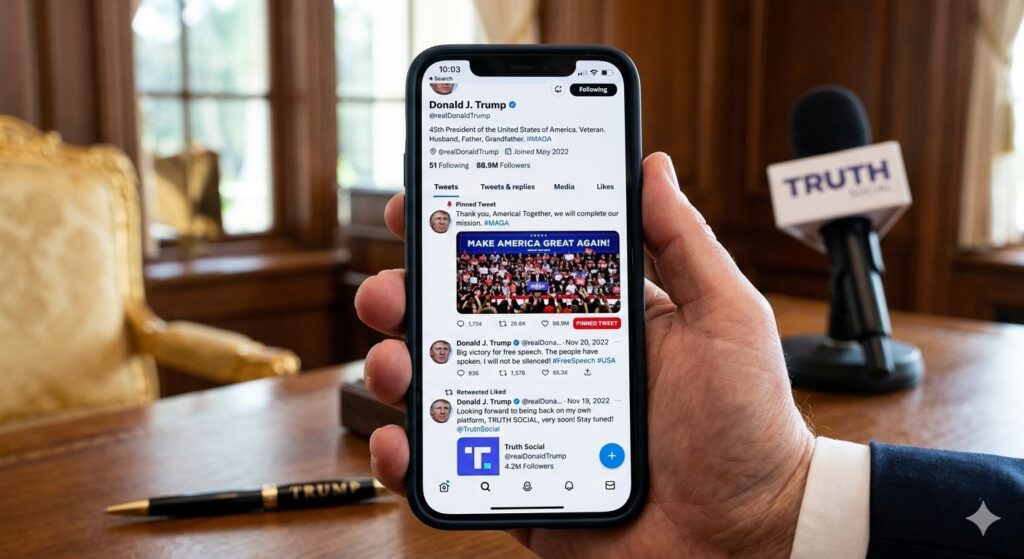
The coverage of Donald Trump’s recent posts on X has followed a familiar, unhelpful pattern. Analysts treat each statement as either a genuine military threat or performative bluster. Both readings miss the point. Neither accounts for the structured logic running underneath the noise.
The standard narrative frames this as Trump being Trump: unpredictable, aggressive, driven by impulse. That frame is wrong, and it is wrong in a consequential way. It leads observers to discount deliberate signals and to misread the pressure campaign as chaos when it is closer to choreography.
This explainer establishes the architecture beneath the posts. Trump Iran strategy in its current form is not primarily a military plan. It is a coercive negotiating instrument, and understanding its components changes what the situation actually predicts.
The Posts Are Not the Policy
Trump’s X posts on Iran have described it as a nation on the verge of destruction. They have promised consequences if nuclear talks fail. They have warned Gulf states against enabling Tehran. Each post generated headlines. None of them constitutes a policy shift.
The actual policy apparatus moved separately. The USS Carl Vinson carrier strike group repositioned into the region. The State Department simultaneously reopened backchannel communications with Iranian intermediaries through Oman. The Treasury Department issued two fresh rounds of sanctions targeting Iranian petrochemical brokers operating through UAE front companies.
Consequently, the posts functioned as atmospheric pressure rather than an operational signal. They kept Iran’s leadership uncertain and satisfied domestic Republican audiences. The real pressure was arriving entirely through quieter mechanisms.
The Nuclear Timeline Forces the Timetable
Iran’s nuclear programme is not a background variable in this situation. It is the central clock. The International Atomic Energy Agency confirmed that Iran had accumulated sufficient 60%-enriched uranium to produce, after further enrichment, approximately three nuclear devices.
Specifically, the threshold that American and Israeli planners treat as a red line is not detonation. It is what the intelligence community calls “breakout capacity,” the point at which Iran could produce weapons-grade material within two weeks without detection. Tehran crossed a preliminary version of that threshold in late 2023. The updated enrichment figures push that window shorter.
Therefore, Trump Iran strategy operates under a genuine constraint that is external to politics. The window for a negotiated freeze, rather than a military intervention, narrows as enrichment stockpiles grow. That is not a rhetorical claim. It is an operational reality that shapes every other decision in this situation.
The Pressure Campaign Has Three Distinct Layers
The architecture of Trump Iran strategy in 2026 runs across three simultaneous tracks. Each track serves a different function, and collapsing them into a single “threat” misrepresents how the campaign actually works.
The first track is economic strangulation. The reimposed and expanded sanctions regime targets oil exports, petrochemical revenue, and access to the SWIFT financial messaging system. Iranian oil exports, which had recovered to approximately 1.5 million barrels per day under the Biden administration’s softer enforcement, have fallen to 900,000 barrels per day under renewed American pressure on buyers, primarily China.
The second track is military signalling. Carrier deployments, B-52 overflights of the Gulf, and coordination with Israeli Air Force units in joint exercises all communicate capability without committing to a timeline. Notably, these signals are calibrated to be visible to Iranian military planners without triggering a formal Iranian response that would require escalation.
The third track is diplomatic conditionality. The Oman backchannel carries a specific American offer: a freeze on enrichment above 20%, a return to IAEA inspections, and the release of American detainees in exchange for phased sanctions relief. This offer has not been publicised by Washington, but Iranian Foreign Minister Abbas Araghchi referenced its existence indirectly in a speech to the Iranian parliament.
Also Read: [Headline Placeholder]
What Tehran Calculates, and Why It Has Not Yet Conceded
Iran’s supreme leadership, specifically Ayatollah Ali Khamenei, operates on a doctrine of “resistance economy”: the belief that external pressure must be absorbed rather than accommodated, as accommodation invites further demands. This is not irrational from within its own logic. The 2015 JCPOA, which Iran signed, produced sanctions relief that lasted three years before America unilaterally withdrew. Tehran’s institutional memory of that episode makes concession politically toxic inside the system.
However, the economic pressure in 2026 operates at a different level of intensity than in 2018. The rial has lost approximately 35% of its value since January 2026. Inflation inside Iran runs above 40%. The Revolutionary Guard Corps, which controls significant commercial and industrial interests, faces direct financial pressure from petrochemical sanctions that target its revenue streams.
Subsequently, the internal politics of Iran are not monolithic. President Masoud Pezeshkian, elected on a reformist platform in 2024, has signalled openness to a revised deal. Khamenei has not publicly blocked talks. The space between those two positions is where Trump Iran strategy is designed to operate, widening the gap between those within the system who want relief and those committed to resistance.
The Israeli Dimension Reshapes the Calculus
No reading of Trump Iran strategy is complete without accounting for Israel’s operational role. Prime Minister Benjamin Netanyahu met Trump at the White House. The public statement mentioned Gaza. The private discussions, confirmed by three separate sources in Israeli media, covered Iran strike planning in considerable detail.
Israel’s position is structurally different from America’s. For Washington, a nuclear-armed Iran is a serious regional problem. For Tel Aviv, it is an existential one, at least within the doctrine that Israeli governments have publicly committed to for two decades. That asymmetry gives Israel both a stronger motivation to act unilaterally and significant leverage over American policy.
Specifically, Trump’s calculus includes the knowledge that if diplomacy fails and Iran continues enrichment, Israel will strike Iranian nuclear facilities with or without American approval. An Israeli strike without American coordination creates enormous risks: Iranian retaliation against American assets in Iraq, Syria, and the Gulf; disruption of regional oil flows; and a war that pulls in Washington despite Washington’s preferences.
Therefore, Trump Iran strategy includes a secondary purpose: keeping Israel restrained long enough for coercive diplomacy to work, while signalling to Tehran that American restraint of Israel is conditional on Iranian behaviour. That is a sophisticated three-way pressure structure that the “Trump tweets threats” framing entirely obscures.
Also Read: The Deal Is the Distraction: Inside the US-Iran Nuclear Standoff
The Gulf States Are Not Passive Observers
Saudi Arabia and the UAE occupy a position in this situation that media coverage consistently underplays. Both states normalised, or began normalising, relations with Israel under the Abraham Accords framework. Both states share the American and Israeli concern about Iranian regional ambitions, particularly in Yemen, Iraq, and Lebanon. Both states also maintain significant economic relationships with Iran across the Gulf.
Notably, Saudi Arabia hosted indirect Iranian-American communication in 2024. Riyadh’s calculation is that a managed, negotiated outcome serves its interests better than either a nuclear Iran or a military conflict that simultaneously disrupts Gulf security and oil markets. The Saudi position gives Washington a regional stakeholder with independent lines to Tehran, which American diplomacy is actively using.
The Pattern This Moment Repeats
Trump Iran strategy in 2026 is not historically unprecedented. It follows the coercive-diplomacy template applied to North Korea between 2017 and 2019: maximum economic pressure, public rhetorical escalation, and a simultaneous backchannel offer with specific conditions. That sequence produced the Singapore summit but no lasting nuclear agreement.
The North Korea comparison is instructive precisely because it shows both what the strategy can achieve and where it fails. It can bring a counterparty to the table. It cannot, by itself, resolve the underlying security dilemmas that make nuclear programmes attractive to regimes that feel existentially threatened. Iran’s nuclear programme is, in significant part, a response to the fate of Muammar Gaddafi, who gave up his weapons programme and was subsequently removed from power. That lesson is not lost on Tehran’s leadership.
What the Next 90 Days Determine
The Oman backchannel has a functional deadline. Iranian presidential politics, Khamenei’s health and the succession questions it raises, and the narrowing enrichment window collectively compress the diplomatic space into a roughly 90-day window running through mid-2026.
If a framework agreement emerges, it will be structured to allow Trump to claim a historic win while giving Iran measurable sanctions relief. If talks collapse, the probability of an Israeli military action, with or without American coordination, rises significantly. Trump Iran strategy is therefore not an open-ended pressure campaign. It is a bounded coercive play with a visible horizon.
The social media posts will continue. They are part of the instrument. The outcome, however, depends entirely on decisions being made in the backchannel, not on X.